Why would anyone give away an AI model that cost hundreds of millions of dollars to train?
The Apparent Paradox
Frontier models burn $100M+ in compute, power, and talent. Business instinct says: lock it up and charge per token — exactly what OpenAI and Anthropic do, supporting valuations in the hundreds of billions. Yet Meta, Nvidia, Alibaba, and DeepSeek release their models for broad download and commercial use (within license terms).
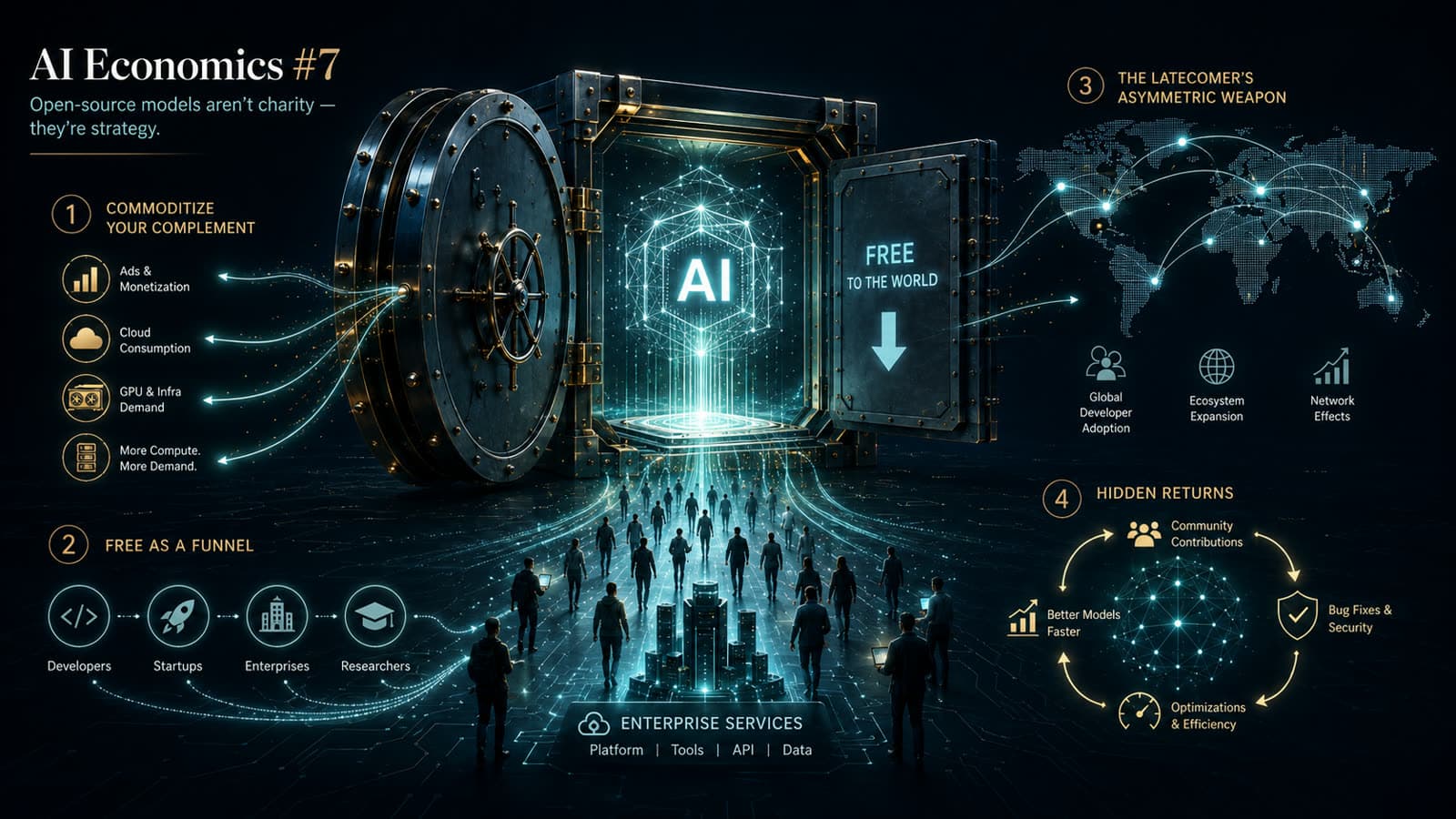
This isn't charity. There are four distinct strategic plays:
Commoditize Your Complement
1️⃣ Commoditize your complement. Meta's business is ads, not models. If AI capability were monopolized by OpenAI, every future Meta product would pay a tax to a rival. Open-sourcing Llama turned "the model" into a cheap commodity, attacking competitors' moats while leaving Meta's ad business untouched. (Notably, reports suggest Meta has been shifting toward a closed/hybrid approach in 2025–26 — but the Llama years are the textbook case of this logic.) Nvidia's Nemotron is the mirror image: the model is free, but running it requires GPUs. The model is bait; compute is the product.
Open Weights as Marketing
2️⃣ Free is the ultimate customer funnel. The Red Hat playbook: open weights win reputation, community, and trial users; revenue comes from enterprise deployment, hosted APIs, fine-tuning, and support. For companies like Mistral or Zhipu, open-sourcing is essentially a marketing expense — and likely the highest-ROI marketing in AI.
The Latecomer's Asymmetric Weapon
3️⃣ The latecomer's asymmetric weapon. DeepSeek and Qwen can't out-brand OpenAI head-on. But "free + good enough" gets global developers building on your architecture overnight. Toolchains, tutorials, and downstream products raise switching costs until your tech becomes a de facto standard — the Android logic. Public reports suggest Coinbase cut internal AI spend by nearly half after defaulting engineers to a Chinese open model, and Microsoft has reportedly evaluated open models for parts of Copilot. If accurate, open models are already reaching closed-source giants' core customers. For Chinese firms, add a geopolitical layer: under chip constraints, open-sourcing mobilizes global optimization efforts and wins developing markets that can't afford closed APIs — aligning neatly with industrial policy goals.
Hidden Returns
4️⃣ Hidden returns. Top researchers prefer teams that publish openly — open-sourcing is a recruiting ad. And the community becomes an unpaid distributed R&D team: bug fixes, optimizations, use cases that feed back into your next model.
The Caveat and the Bottom Line
The caveat: ecosystem wins don't guarantee profit wins. Linux conquered servers, yet Red Hat's profits never rivaled Microsoft's.
In one line: open-sourcing either protects a money-making business, attacks someone else's, or paves the way for a future one.
As for why they "dare" to give it away — what's given is far less than it appears. They ship you the product, not the recipe. That's the next post.
Takeaways
The model is bait; compute is the product.
If accurate, open models are already reaching closed-source giants' core customers.
In one line: open-sourcing either protects a money-making business, attacks someone else's, or paves the way for a future one.
Was this useful?