Why Robot Companies Are Suddenly "Scrambling for Grain": The Data War in Embodied AI Is Not What You Think
Yesterday, I wrote about why AI now needs a body. Today I want to go one level deeper and ask:
When AI does get a body, why do robot companies suddenly act like they're in a "grain rush"? And why is this data war in embodied AI very different from the data battles we're used to in the internet and LLM era?
On the surface, the answer sounds trivial: "Robots need data to learn actions. Of course they're competing for data."
If we stop there, there's nothing interesting. The real story starts when you notice three less obvious facts:
Robots are not chasing the kind of data you probably think of first.
The data they need mostly doesn't exist online—it has to be manufactured in the physical world.
Whoever can turn that data manufacturing into a compounding feedback loop is the one who will really pull ahead in embodied AI.
Let's unpack these three points.
1. Robots Chase Their Own Experience
Robots aren't competing for your data – they're competing for their own experience. When we hear "data race", our minds go to:
- Platforms fighting for user behavior and transaction logs
- LLM companies scraping text, images, and video
- Debates over privacy, consent, and data regulation
In embodied AI, the most strategic data looks completely different.
A useful robot dataset isn't "what users clicked". It's: what the robot saw, felt, did, and what happened next, in a real environment.
A single high‑quality embodied interaction usually includes:
- what the robot saw: multi‑view video, depth, pose, scene state
- what it felt: forces, torques, tactile signals, joint angles, velocities, accelerations
- what it did: control commands, end‑effector trajectories, grasp/release events
- how the environment responded: success or failure, slips, collisions, object motion
- the task context: what the robot was trying to accomplish, expected outcome, safety constraints
It's essentially a detailed "action diary" of the robot, not a user profile.
So when we say robot companies are scrambling for data, what they're really scrambling for is:
Records of "what our robots have already done, under what perception, with what results."
That's the first key difference: they're chasing their own embodied experience, not your browsing history.
2. Manufacturing Data in the Physical World
In the LLM era, we internalized a simple playbook: want a smarter model? scrape more internet data, clean and deduplicate it, then train.
In embodied AI, this playbook breaks.
Why? Because the internet simply doesn't contain the multi‑modal physical interaction data robots need.
You can watch 10,000 "how to pour water" videos. For a robot, those clips are still missing critical dimensions:
- no material properties: no friction, compliance, actual fluid dynamics
- no control signals: no fine‑grained force profiles, joint torque patterns, nozzle angle vs. flow rate
- no closed loop: no mapping from sensed state → control command → outcome that a controller can directly learn from
That's why embodied AI reports keep repeating a blunt reality: the data robots need is not "lying around" on the internet. It has to be produced, one interaction at a time, in the real or high‑fidelity simulated world.
This is the second meaning of "scrambling for grain": not "who owns more stored data", but "who has the stronger capacity to produce the right data continuously."
Concretely, this means: you need real robots or realistic simulators that give models a stage to act and fail safely; you need humans designing tasks, overseeing safety, teleoperating, correcting, labeling results; you need sensor rigs, data pipelines, synchronization, cleaning, annotation, storage.
Text and images are the "digital by‑products" of decades of human activity online. Embodied data is the primary product of today's robot activity in the physical world.
In the LLM era, the game was: "who can find more data." In embodied AI, the game is: "who can manufacture more of the right data, faster and safer."
That's the second big difference.
3. Embodied Data as a Durable Moat
In the web era, data often behaved like a tradable resource: compute can be rented, models can be open‑sourced, algorithms can be copied; data could in theory be licensed or exchanged, if regulation allowed.
In robotics, embodied data is turning into something harder to copy and harder to trade. It's starting to look like a true moat, not just a one‑off asset.
Three reasons:
(1) Data is tightly bound to specific scenes. A robot interaction is always a bundle: this specific robot + this specific factory/warehouse/home + this specific task + this specific material + this specific safety protocol
Change the robot, the environment layout, the task type, and a lot of data becomes less useful or needs heavy adaptation.
For robot companies, this means: thousands of hours of data from your robot in your customer's factory may not transfer cleanly to my robot in my factory. Even with sharing, migration cost is high; it's more like semi‑custom expertise than a standard commodity.
The more complex and business‑specific the scene, the stronger this binding becomes.
(2) Data is a production line, not a one‑time stockpile
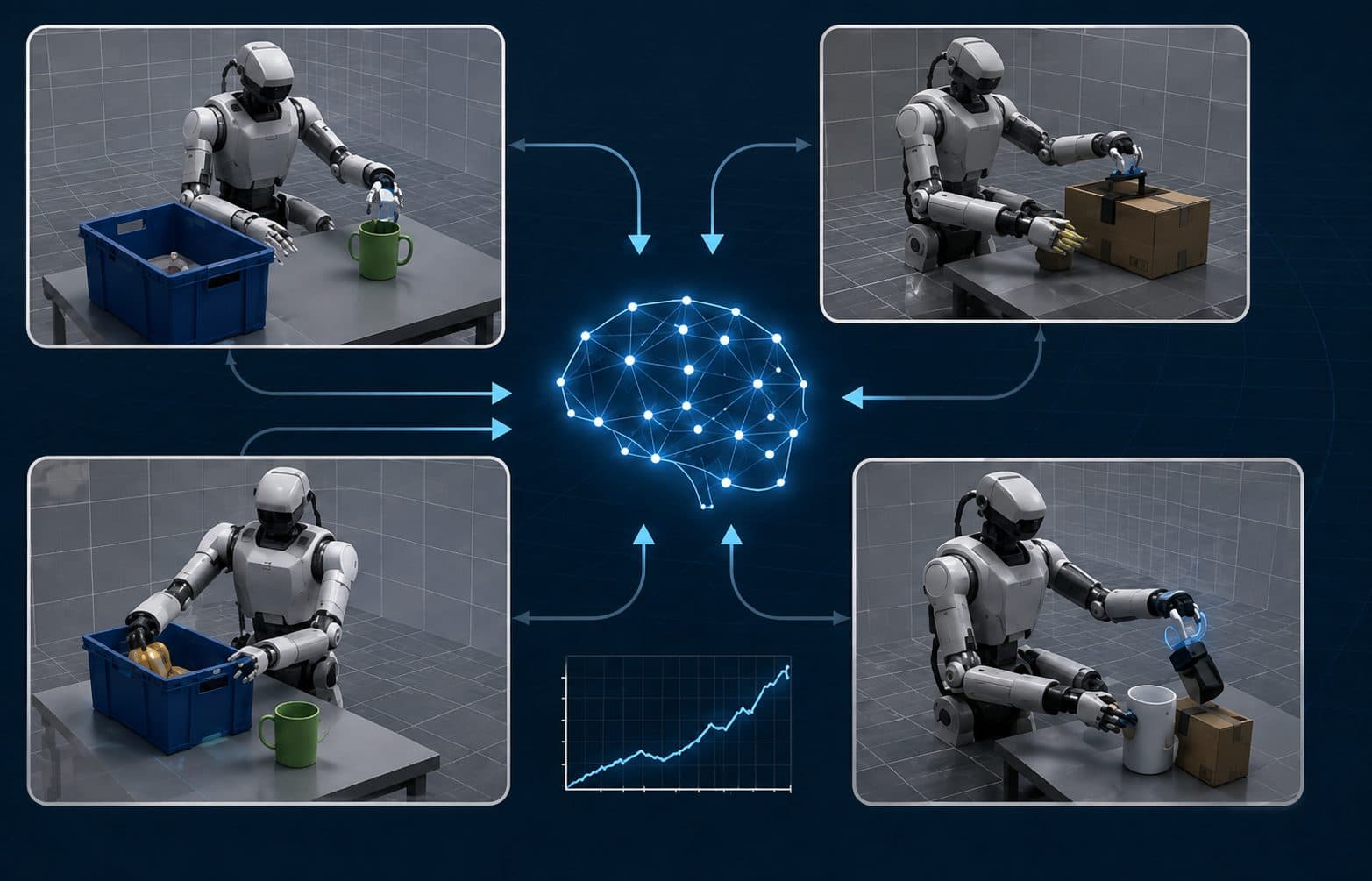
Embodied data behaves like a production line: the more robots you deploy, and the longer they run, the more data you accumulate: more data → better models → more capable robots → more deployments → more data. This is the classic data flywheel.
Data isn't just something you buy once; it's something you produce continuously.
The competition naturally shifts to: who can spin up their "data factory" earliest, keep it running safely at high throughput, and compound the gains.
You can think of it this way: models are engines; environments are race tracks; data is fuel; data generation capacity is your oil field
(3) Many of the most valuable datasets won't—and often can't—be widely shared
Embodied data is often deeply intertwined with a company's operations: process details, equipment layouts, optimization logic, safety responses, exception handling, internal SOPs, and, in some industries, even core trade secrets. It's not something enterprises casually open‑source or wholesale license. Over time, each serious robot company builds up: a private, scene‑specific library of experience that only they fully understand and can exploit.
Outsiders can see the robots and the videos. They can't easily see—or reuse—the full "decision DNA" embedded in that data.
That's why more and more leaders in the space are saying, implicitly or explicitly: "Our edge is not just in robots and algorithms. It's in the data loop behind them."
From Finding Data to Defending It
A one‑line summary: from "finding data" to "manufacturing and defending data"
If I had to compress this into a single sentence, it would be: In the LLM era, the race was "who can find more existing data." In the embodied AI era, the race is "who can continuously manufacture their own data in the real world—and turn that into a long‑term moat."
Takeaways
That's why embodied AI reports keep repeating a blunt reality: the data robots need is not "lying around" on the internet. It has to be produced, one interaction at a time, in the real or high‑fidelity simulated world.
In the LLM era, the game was: "who can find more data." In embodied AI, the game is: "who can manufacture more of the right data, faster and safer."
In robotics, embodied data is turning into something harder to copy and harder to trade. It's starting to look like a true moat, not just a one‑off asset.
Was this useful?