Why Most Companies Using AI Still Aren't AI-Native Organizations
Over the past two years, many companies have started equipping employees with ChatGPT, Claude, or other large language models. Some have deployed AI-powered customer service, knowledge management systems, and meeting assistants. Others use AI to write code, generate marketing copy, analyze data, or even experiment with AI agents.
But I often find myself asking: does a company that uses AI extensively automatically become an AI-native organization?
The widespread adoption of AI has undoubtedly transformed the tools we use to work. But becoming AI-native requires something much deeper. It means fundamentally changing how an organization operates—not simply helping people complete existing work faster, but redefining how work itself is designed, decomposed, assigned, validated, and owned.
AI Native Is Not About Adding AI to Existing Processes
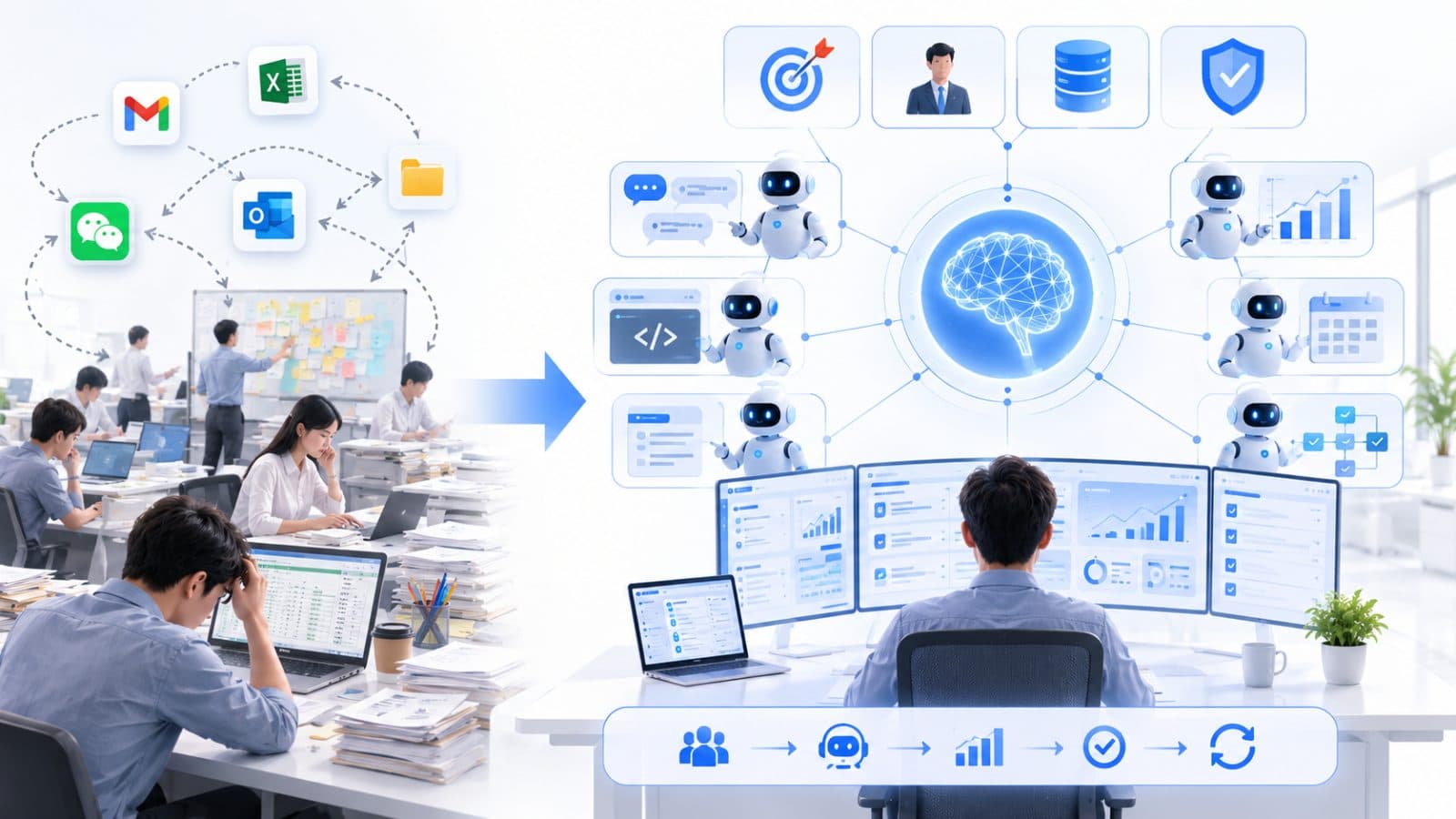
Many companies are still in what I would call the "AI augmentation" stage. Employees use AI to write weekly reports. Customer service teams generate responses with AI. Salespeople polish emails. HR screens resumes. Executives summarize meetings. These applications are valuable—but they mostly make existing workflows more efficient. The underlying organization remains unchanged: Information is still scattered across spreadsheets, chat groups, emails, meetings, and disconnected systems. Processes still depend on employees forwarding messages, chasing approvals, copying and pasting information, and relying on personal experience. Organizational knowledge still resides primarily in the heads of a small number of experienced employees. A more accurate description of these organizations would be AI-enabled rather than AI-native.
A truly AI-native organization redesigns its basic operating unit around AI as a cognitive and execution infrastructure: Business Objective + Human Owner + AI Agents + Data & Tools + Validation & Feedback
In this model, AI is no longer an occasional chatbot employees open when they need help. Instead, it becomes embedded throughout everyday workflows. AI continuously reads context, retrieves knowledge, breaks down tasks, calls software systems, coordinates handoffs, detects anomalies, and completes portions of actual operational work within defined permissions. Meanwhile, humans shift away from transporting information, filling repetitive forms, coordinating across departments, and organizing basic data. Instead, people focus on four responsibilities: - Defining objectives - Handling exceptions - Exercising judgment - Taking accountability for outcomes
A Simple Test for Whether a Company Is AI Native
A useful question to ask is: What would happen if every AI system disappeared tomorrow? If the answer is: "People would become less efficient, but work would continue." Then AI is probably still functioning as a productivity tool. But if the answer is: "Customer service, content creation, engineering collaboration, risk monitoring, operational scheduling, and other critical workflows would immediately break down, forcing the organization back into slow manual coordination." Then AI has become part of the organization's operating system.
However, there is another danger. Some companies appear AI-native while actually outsourcing their organizational intelligence to a single model provider. If that model becomes unavailable, raises prices, changes performance characteristics, or experiences outages, the organization quickly falls into chaos. That isn't AI-native. It's AI dependency.
Models Are Not the Foundation of an Organization
Recently, some people have argued that Claude Code finally makes truly AI-native organizations possible. There is some truth in that statement—but it is also easy to misunderstand. Claude Code's importance is not that it invented AI agents. Its real contribution is that it helped many people experience, for the first time, that AI can do far more than answer questions. It can understand complex context, invoke tools, modify files, execute tests, and complete substantial portions of real work. It transformed the idea of one person working alongside multiple AI execution units from an abstract concept into an everyday workflow.
But Claude Code itself is not the foundation of an AI-native organization. It is better understood as a general-purpose assembly tool—one that enables teams to build products, workflows, and internal systems more efficiently.
The true foundation still belongs to the enterprise itself: - Customer, order, project, employee, and operational data - Reusable business rules and organizational knowledge - Machine-readable workflows and handoff mechanisms - Clearly defined permissions and responsibilities - Error detection, human intervention, and rollback mechanisms - Continuous improvement based on real business outcomes
A mature AI-native organization cannot be built on top of any single model. Models should be treated as a replaceable intelligence layer—as important as cloud infrastructure, databases, or electricity—but never as the company's sole control center.
Which Businesses Are Best Suited for AI-Native Organizations?
Not every industry will evolve toward AI-native organizations at the same pace. The determining factor isn't whether a company operates in software, manufacturing, finance, or services. The key question is whether its business contains an AI-reconstructable closed loop:
Input → Analysis → Tool Execution → Outcome → Feedback
When a workflow is: - High frequency - Easily decomposed - Measurable - Connected across systems - Reversible when mistakes occur
…it becomes an excellent candidate for AI-native transformation.
Software development is perhaps the clearest example. Requirements, code, testing, deployment, incidents, and customer feedback all exist inside digital systems. Tasks can be decomposed. Results can be validated. Mistakes can be rolled back through version control. This naturally enables a collaboration model where: A small number of humans define objectives, multiple AI agents execute work, and automated systems validate quality. Customer operations, sales, marketing, consulting, research, and shared service centers exhibit many of these same characteristics.
The Biggest Risk: Will Organizations Become More Fragile?
One paradox of AI-native organizations is often overlooked. The deeper AI becomes embedded, the greater the potential efficiency. But unless designed carefully, the organization may also become more fragile.
AI failures rarely appear as complete system crashes. More commonly: Model quality quietly deteriorates. An agent misinterprets external information. Prompt injection introduces malicious instructions. An over-privileged agent modifies customer records. Incorrect notifications are sent. Irreversible actions are triggered. Therefore, AI-native organizations cannot pursue autonomy alone. They must also pursue controllability. At a minimum, mature organizations should establish four safeguards:
AI should receive only the minimum permissions necessary to complete its assigned tasks. Irreversible decisions—including payments, hiring, termination, external communications, contracts, and production changes—must require human approval. Every critical action should be logged, evaluated, and assigned to an accountable owner. Organizations must be able to switch models, degrade gracefully, and transfer control back to humans whenever model quality declines or systems are compromised.
The future of AI-native organizations should not be an autonomous machine with no accountability. It should be an organization where responsibilities are more clearly defined: Who decides. Who executes. Who is accountable. Who learns.
Where Should Companies Start?
For most organizations, becoming AI-native will not begin with a dramatic company-wide transformation. It will begin with solving one concrete business problem. For example: Helping customer service reduce repetitive inquiries while resolving issues faster. Creating a closed-loop workflow from lead research to follow-up for sales teams. Connecting requirements, development, testing, and deployment for engineering teams. Enabling staffing firms to unify job requests, candidate matching, scheduling, and field feedback into a single operational system.
The best starting point is not the most sophisticated AI agent. It is a workflow that is: - High frequency - Clearly painful - Easily measurable - Safe to roll back when mistakes occur
Companies should stop asking: "What can AI help us do?" Instead, they should ask: "Which parts of our business still rely on people manually transferring information, coordinating repeatedly, and remembering organizational knowledge?"
If those workflows can be redesigned into human-AI collaborative closed loops, what entirely new capabilities might the organization gain? That is where the journey toward becoming AI-native truly begins.
AI Native Is a New Production System
Ultimately, the essence of an AI-native organization has never been doing more work with fewer people. It is about transforming the organization into a continuously learning production system. Humans define objectives, exercise judgment, and take responsibility. AI performs large-scale cognition, execution, and coordination. Data and feedback continuously accumulate organizational capability—creating compounding advantages over time.
Takeaways
Becoming AI-native requires something much deeper. It means fundamentally changing how an organization operates—not simply helping people complete existing work faster, but redefining how work itself is designed, decomposed, assigned, validated, and owned.
Data and feedback continuously accumulate organizational capability—creating compounding advantages over time.
Was this useful?