# Why Is the World Racing to Build Humanoid Robots When So Many People Still Can't Find Jobs?
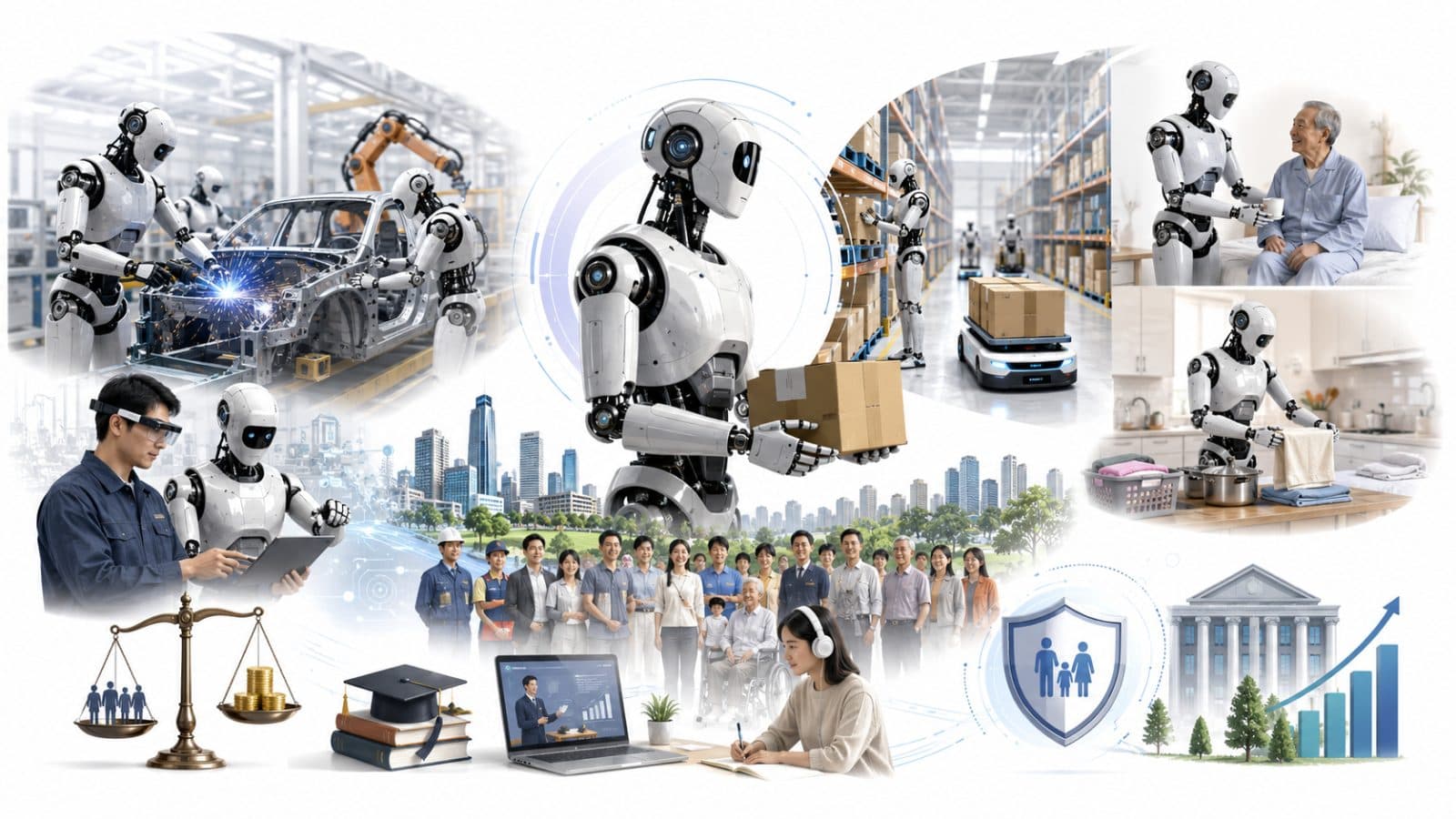
Humanoid robots are having a moment. They can walk, carry boxes, fold clothes, serve drinks, and work in factories and warehouses. Investors are pouring in money, governments are offering support, and technology companies are constantly unveiling new models.
This naturally raises a question: if so many people are still struggling to find jobs, why is society investing so much money, talent, and resources in developing robots that could potentially replace human workers?
What Problem Are Humanoid Robots Actually Trying to Solve?
The real goal of humanoid robots is not to "make machines look like humans." It is to push automation beyond fixed, repetitive tasks that require highly engineered environments, and into real-world settings where work has traditionally depended on people.
Industrial robotic arms, warehouse robots, and automated production lines are already highly mature. But they usually operate in tightly standardized environments: components must be placed in fixed positions, routes must be predefined, specialized fixtures must be designed, and workflows often need to be reorganized around the machines.
These systems can be extremely efficient, but they struggle in environments that are messy, constantly changing, dependent on general-purpose tools, or full of unexpected situations.
Humanoid robots aim to fill this gap.
The ambition is to allow AI to move beyond screens and the cloud—to understand its surroundings, follow verbal instructions, move through physical spaces, pick up tools, and perform tasks that currently depend on the capabilities of the human body.
In other words, humanoid robots are trying to overcome one of the biggest limitations of automation today: **its dependence on highly standardized tasks and environments.**
Why humanoid form?
Because the world around us was designed for humans.
Door handles, stairs, elevator buttons, factory workstations, shelf heights, kitchen counters, warehouse aisles, and handheld tools all assume that the user can walk, reach, bend, and manipulate objects with two hands.
The bet behind humanoid robotics is therefore straightforward: instead of rebuilding the physical world around automation, build robots that can operate in spaces already designed for people and use tools that already exist.
Their real value is not that they "look human," but whether they can become **general-purpose labor platforms capable of learning, switching tasks, and operating across different environments.**
Why Are Companies Investing in Humanoid Robots?
When companies invest in mature forms of automation, they usually expect a relatively predictable return: lower unit costs, more stable production capacity, fewer quality fluctuations, or reduced labor-related risks.
For standardized tasks such as welding, palletizing, sorting, and inspection, companies can compare the full lifecycle cost of human labor with the cost of purchasing, integrating, maintaining, and operating automated equipment. If the payback period makes sense, specialized robotic arms, AGVs/AMRs, or automated production lines are usually better investments than humanoid robots.
Humanoid robotics follows a different logic.
Today, humanoid robots are often still more expensive, less reliable, and less efficient than specialized equipment. Companies buying them are therefore not necessarily trying to replace a certain number of workers immediately.
Instead, they are often buying three things: **the possibility of deploying automation inside existing factories and warehouses, access to real-world operational data, and the option to rapidly scale automation across more tasks in the future.**
Put differently, specialized robots sell **efficiency that has already been proven today**. Humanoid robots sell **the possibility of greater generality tomorrow**.
That also makes humanoid robotics a high-risk bet.
Whether humanoid robots ultimately deserve large-scale deployment will not depend on whether they can walk like humans. It will depend on whether they can reliably perform useful tasks in real workplaces—and whether their costs eventually approach or outperform both human labor and existing specialized automation.
Why Are Governments Willing to Make the Same Bet?
Companies pursue profits. Governments tend to look further ahead.
The first reason is demographics.
Many economies are aging. Their working-age populations are growing more slowly or even shrinking, while demand for healthcare, elderly care, logistics, manufacturing, and other essential services continues to rise. The OECD has warned that population aging could weigh on long-term GDP per capita growth, making higher labor-force participation and productivity increasingly important.
The second reason is industrial competition.
Humanoid robots are not simply standalone products. Behind them sits an entire technology stack: high-performance motors, reducers, sensors, machine vision, control systems, dexterous hands, edge-computing chips, embodied AI models, and robotics data.
These technologies can be applied not only to robotics but also to advanced manufacturing, medical devices, aerospace, public safety, and defense industries.
From a government's perspective, investing in robotics is therefore not simply a question of "how many workers might robots replace?"
It is also a race to secure positions in next-generation manufacturing, supply chains, technical standards, and data platforms.
In this sense, robotics is increasingly viewed both as **productivity infrastructure and as strategic industrial capability**.
The Real Question Is Not "Should We Build Them?" but "Who Are They For?"
There are two dangerous extremes in discussions about humanoid robots.
One is technological optimism: the belief that technological progress will automatically make everyone's life better.
The other is technological pessimism: the belief that robots will inevitably cause mass unemployment and therefore should not be developed.
Reality is more complicated.
Robots generally replace tasks before they replace entire occupations.
A warehouse worker's job, for example, may involve carrying goods, inspecting items, communicating with colleagues, handling exceptions, coordinating with others, and making temporary decisions. A robot may take over the most repetitive or dangerous parts of that job without immediately replacing the entire role.
Research by the International Labour Organization on AI has similarly emphasized that technological change is often more likely to transform job content and job quality than to make entire occupations disappear.
But that should not become a source of false reassurance.
Even if entire professions do not disappear, social pressure is still very real if certain jobs shrink, wages fall, or workers lose bargaining power.
This becomes particularly important when the economic gains from automation are concentrated among equipment owners, platform companies, core-component manufacturers, and those who control the data.
Higher productivity does not automatically translate into higher incomes for most people.
So the key question is not simply:
**Will robots replace humans?**
It is:
**Who owns the robots? Who captures the productivity gains? And who bears the cost of unemployment and economic transition?**
Technological Progress Needs Social Progress to Keep Pace
The better path is not to stop technological development, but to establish clearer social conditions around how these technologies are deployed.
First, robots should be prioritized for jobs that people should not have to perform for long periods of time—dangerous, physically damaging, extremely repetitive work, as well as roles facing genuine and persistent labor shortages.
Second, companies adopting automation should not treat it simply as a tool for reducing headcount. Part of the productivity gains could be shared through shorter working hours, higher wages, employee profit-sharing, job upgrading, and paid retraining programs.
Third, retraining cannot remain a slogan. Workers need training with income protection, real jobs they can move into, genuine opportunities for internal mobility, and enough economic security to survive the transition.
Fourth, governments need to consider how social protection, vocational education, taxation, and public investment can ensure that the benefits of automation do not flow only to the owners of capital.
The future worth hoping for is not one in which humanoid robots push humans out of the labor market.
It is one in which machines take over dangerous, repetitive, and physically exhausting work, while people gain access to safer, more creative, and more dignified forms of employment.
Technology is never simply a neutral force of destiny.
It can become a tool that allows a small number of people to increase profits, or it can become infrastructure that helps society reduce suffering, raise productivity, and improve people's lives.
**Which future humanoid robots ultimately create will depend not only on algorithms, motors, and data, but also on how we choose to distribute the wealth they create.**
Takeaways
Put differently, specialized robots sell efficiency that has already been proven today. Humanoid robots sell the possibility of greater generality tomorrow.
Whether humanoid robots ultimately deserve large-scale deployment will not depend on whether they can walk like humans. It will depend on whether they can reliably perform useful tasks in real workplaces—and whether their costs eventually approach or outperform both human labor and existing specialized automation.
Humanoid robots are not simply standalone products. Behind them sits an entire technology stack: high-performance motors, reducers, sensors, machine vision, control systems, dexterous hands, edge-computing chips, embodied AI models, and robotics data.
Who owns the robots? Who captures the productivity gains? And who bears the cost of unemployment and economic transition?
Which future humanoid robots ultimately create will depend not only on algorithms, motors, and data, but also on how we choose to distribute the wealth they create.
Was this useful?