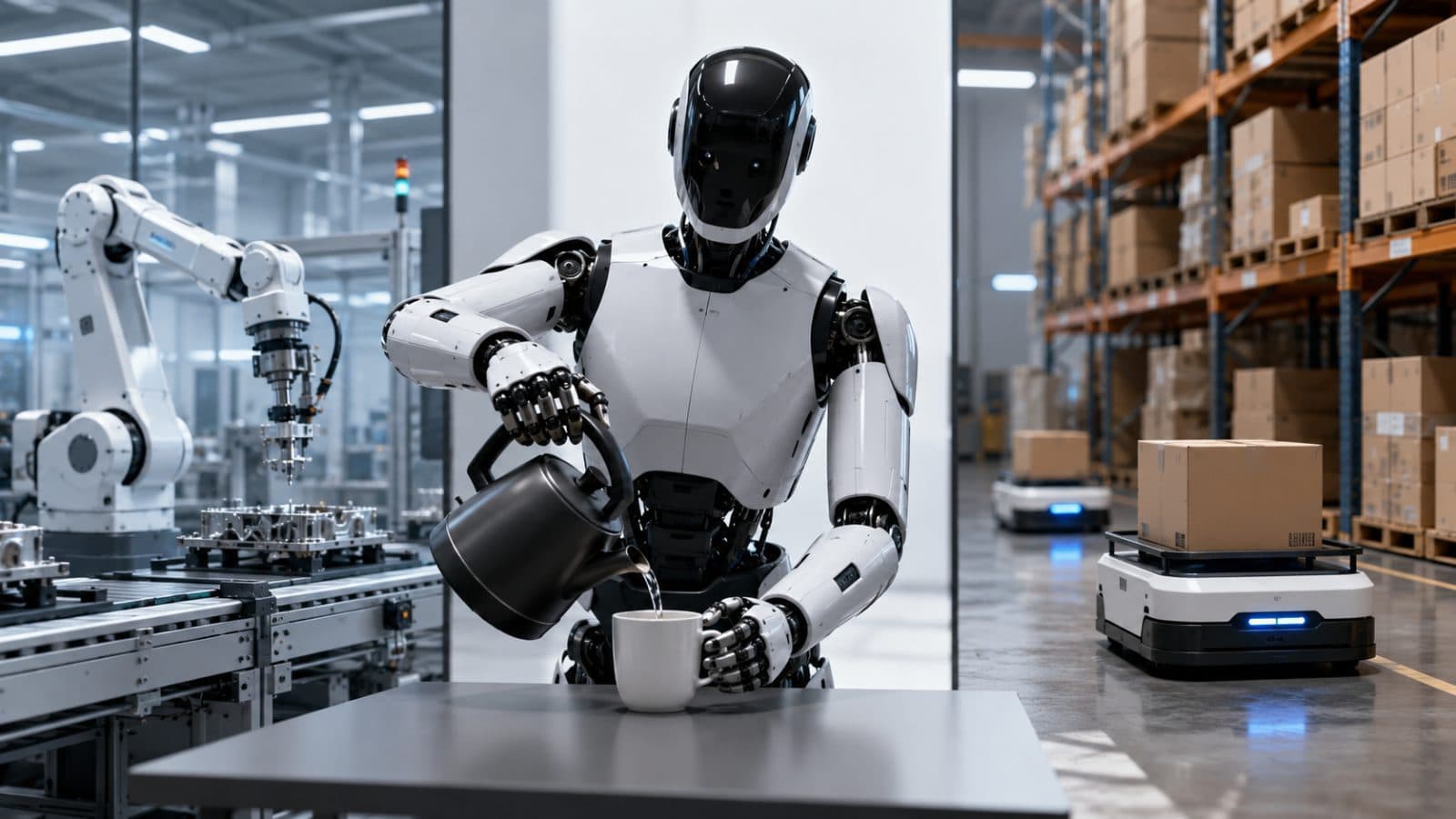
Why AI Now Needs a "Body": Embodied AI and Its Big Roadblocks
For years, our mental image of AI has been a chatbot on a screen: models that can write, code, draw, and summarize. But look at recent headlines—humanoid robots in factories, warehouse bots, AI-powered logistics—and one phrase keeps coming up: embodied AI.
In simple terms, embodied AI means systems that don't just "say" things, but actually "do" things in the physical world: perceive, decide, act, and learn from the consequences.
From Cognitive to Labor Automation
1. So far, AI has mostly automated cognitive work: content creation, coding, data analysis, design. All of this lives in the symbolic world of text, images, and code.
The next big cost pools are in physical labor:
- Manufacturing and assembly
- Warehousing and logistics
- Retail operations
- Healthcare and eldercare
- Domestic services
These jobs share three traits:
- They happen in real, messy environments.
- They require continuous interaction with people, tools, and objects.
- Mistakes don't just waste time; they break things or create safety risks.
If AI only "advises" but never acts, it captures only a small slice of economic value. To automate labor in the real world, AI needs a body.
Acting, Not Just Describing
You can't fully understand the world by reading about it. A large model can describe "how to pour water into a cup" in perfect language. But driving a real robot arm to pour water is different:
- Is the cup stable? Is the table tilted?
- How does the water surface move?
- Is the cup glass or paper—can we crush it?
These details don't exist in text or static images. They show up only when the system acts and observes what happens.
Embodied AI is about creating this loop:
Perceive → Act → Get feedback → Update strategy
Without a body, this loop never closes. The model stays in "paper plan" mode forever.
And once AI acts in the real world, the bar rises: we don't just ask "can it do the task?", but "can it do it safely and reliably under uncertainty?"
The Physical Data Scarcity Problem
The first big roadblock: data scarcity in the physical world. In the large language model era, data felt "infinite"—you could scrape the internet and get trillions of tokens.
Embodied AI is the opposite. Physical data must be actively produced, one interaction at a time, with actual robots in real environments.
Industry estimates look like this:
- High‑quality real‑world embodied interaction data today: hundreds of thousands of hours, globally.
- Data needed to train a truly general embodied foundation model: tens of millions of hours or more.
One expert estimate: R&D teams globally demand ~1.2 million hours of high‑quality embodied data, but the industry only produces 250–300k hours per month. Demand and supply are deeply misaligned.
Why so hard?
Data must be multi‑modal and time‑aligned: vision + force + touch + pose + control commands.
Hardware is expensive: teleoperation rigs and humanoid robots cost tens or hundreds of thousands per setup.
Collection is slow: human operators can only produce limited "valid samples" per day, followed by costly cleaning and labeling.
Robots are diverse: different form factors, sensors, and control interfaces mean poor cross‑robot reuse.
In short: embodied data is not "found," it is "manufactured"—through real experiments in the physical world.
Four More Mountains to Climb
Beyond data: four more mountains to climb. Even with better data pipelines, embodied AI faces several hard challenges.
(1) Generalization: from demo rooms to real world. Many robots look great in controlled demos, then fail in messy reality:
- Lighting, clutter, noise, and human interference
- Long task chains (not just one-off actions)
- Safety constraints (forces, speeds, distances)
Here we care about generalization: can a system handle new environments, objects, and tasks it hasn't seen before, without fine-tuning everything from scratch?
(2) Robustness: staying stable under imperfect conditions. We also care about robustness: can the system stay calm when conditions are slightly off?
- Sensor noise, small pose errors, minor collisions
- Unexpected human interruptions
- Slight deviations from the "ideal script"
In human terms: generalization is "can you handle new situations?", robustness is "do you break down easily when things aren't perfect?"
(3) The Sim2Real gap: when virtual success doesn't survive reality. To save cost and reduce risk, teams train policies in simulation and then deploy to real robots. This is Sim2Real (simulation to reality).
The problem:
Policies that achieve high success rates in sim often perform much worse on real hardware.
This performance drop is the Sim2Real gap or reality gap.
Why?
Physics engines approximate friction, impact, soft materials.
Sim sensors are "clean," real sensors are noisy and biased.
Sim environments are finite and controllable; reality is open‑ended.
A more down‑to‑earth way to say it:
You can be a "champion" in the virtual world and still stumble badly the moment you touch real floors, real cups, real people.
The emerging strategy is:
Use real robots to create a core set of trustworthy demonstrations ("anchor" behavior).
Use simulation to exhaust long‑tail and rare scenarios.
Use cheaper, non‑robot‑specific data to fill remaining gaps and improve coverage.
(4) Hardware, energy, and systems engineering. "Having a body" is an engineering problem as much as a machine learning problem:
Actuators, gearboxes, sensors must survive high load, high frequency, long hours.
Battery and thermal constraints limit continuous runtime—many humanoids today run only a few hours per charge under real workloads.
Motion control and perception must be tightly integrated, with safety and failover logic built‑in.
End‑side compute is limited; you can't strap a data‑center GPU onto every robot, so models must be efficient and split between edge and cloud.
On top of that, software and hardware are still highly coupled. Each robot line is almost its own ecosystem, which slows down iteration and reuse.
A Trajectory, Not a Choice
Why "AI with a body" is a trajectory, not a choice. Put all this together, and the direction of travel becomes clear:
Economically, the biggest untapped value is in physical labor.
Cognitively, true world understanding requires acting and seeing consequences, not just reading.
Technically, we are shifting from "competing on parameters" to competing on embodied data, generalization, robustness, and system design.
Industrially, hardware barriers are falling; data, Sim2Real, and engineering reliability are becoming the new bottlenecks.
If 2022 was the large language model moment, many see the coming years as the embodied AI moment: the phase where AI gradually grows a body and moves from screens into factories, warehouses, stores, and homes.
The key question is no longer "Will AI need a body?" It's "Who will cross the data, Sim2Real, robustness, and engineering gaps first, and turn embodied AI from impressive demos into dependable production?"
Takeaways
Embodied AI means systems that don't just "say" things, but actually "do" things in the physical world: perceive, decide, act, and learn from the consequences.
If AI only "advises" but never acts, it captures only a small slice of economic value. To automate labor in the real world, AI needs a body.
And once AI acts in the real world, the bar rises: we don't just ask "can it do the task?", but "can it do it safely and reliably under uncertainty?"
If 2022 was the large language model moment, many see the coming years as the embodied AI moment: the phase where AI gradually grows a body and moves from screens into factories, warehouses, stores, and homes.
Was this useful?