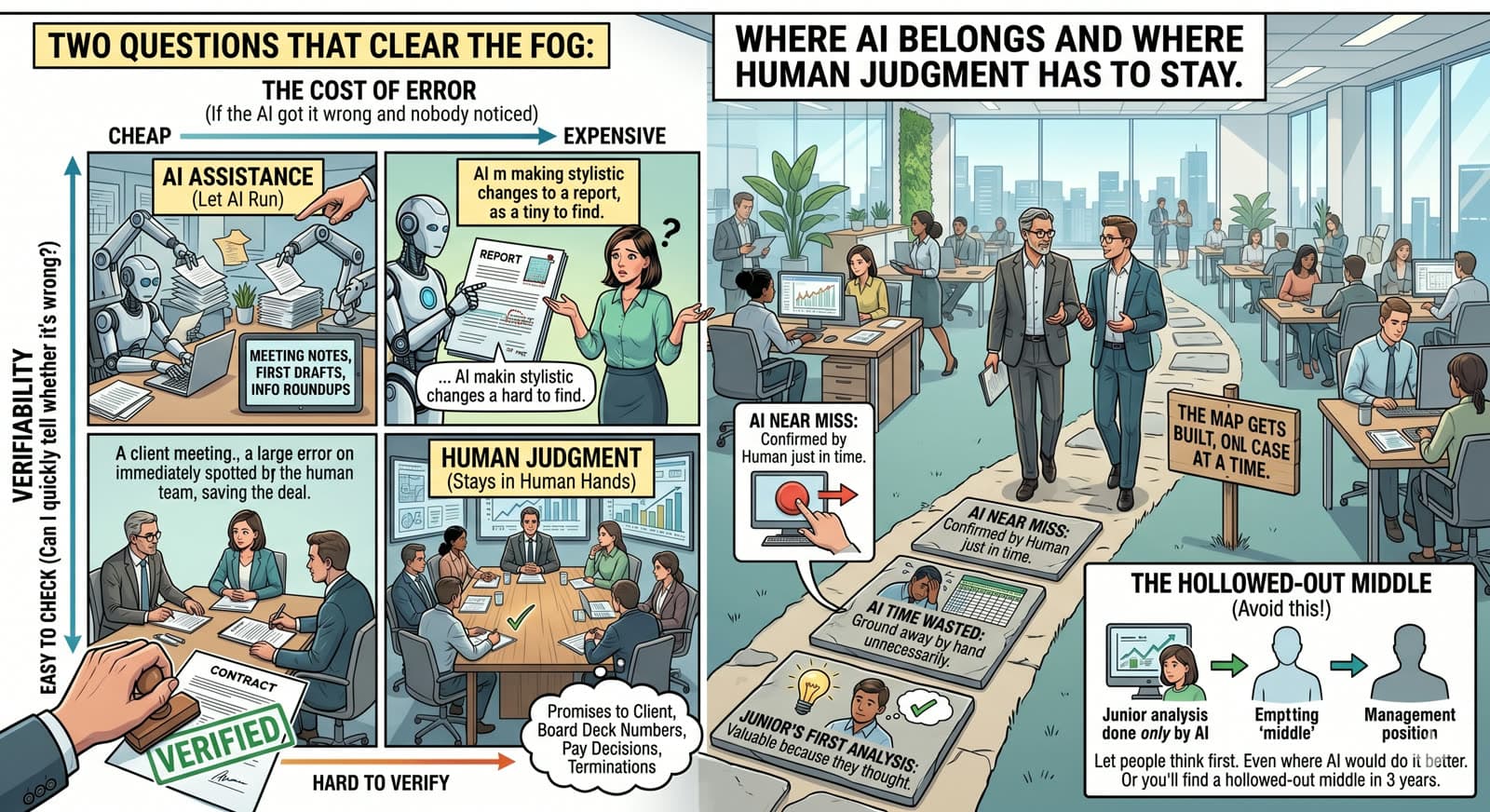
Where AI belongs, and where human judgment has to stay.
"Which tasks do we hand to AI, and which ones must a human still own?" Most managers can't answer this. It's not a competence gap. The question is being asked at the wrong altitude. Ask someone to classify an entire function in the abstract and you'll get mush — because where judgment matters reveals itself in the work, not in a conference room.
Two Questions That Cut Through
Replace it with two questions anyone can answer about a specific piece of work: One: if the AI got this wrong and nobody noticed, what's the worst that happens? (the cost of error) Two: once it's done, can I quickly tell whether it's wrong? (verifiability) Lay those two side by side, and the fog clears.
Low Stakes vs. High Stakes
Cheap to get wrong and easy to check — meeting notes, first drafts, information roundups — let AI run, and stop wasting human hours polishing them. Expensive to get wrong, or hard to verify — promises to a client, the numbers in a board deck, pay decisions, terminations — judgment stays in human hands.
The Hidden Cost of Skipping the Work
And one category deserves its own line. A junior's first analysis isn't valuable because the analysis is good. It's valuable because they actually thought. Even where AI would do it better, let the person do it first — or in three years you'll find a hollowed-out middle.
The Line Gets Built, Not Declared
A last word for HR and managers: this line doesn't get declared in a meeting. It gets built, one real case at a time. Watch for two kinds of moments. Someone trusted AI too much and nearly caused damage. Someone ground away by hand at something AI would've done in five minutes. Capture them. Pass them around. The map gets built. It doesn't get announced.
Takeaways
Expensive to get wrong, or hard to verify, judgment stays in human hands.
Cheap to get wrong and easy to check — meeting notes, first drafts, information roundups — let AI run
Watch for two kinds of moments. Someone trusted AI too much and nearly caused damage. Someone ground away by hand at something AI would've done in five minutes.
Was this useful?