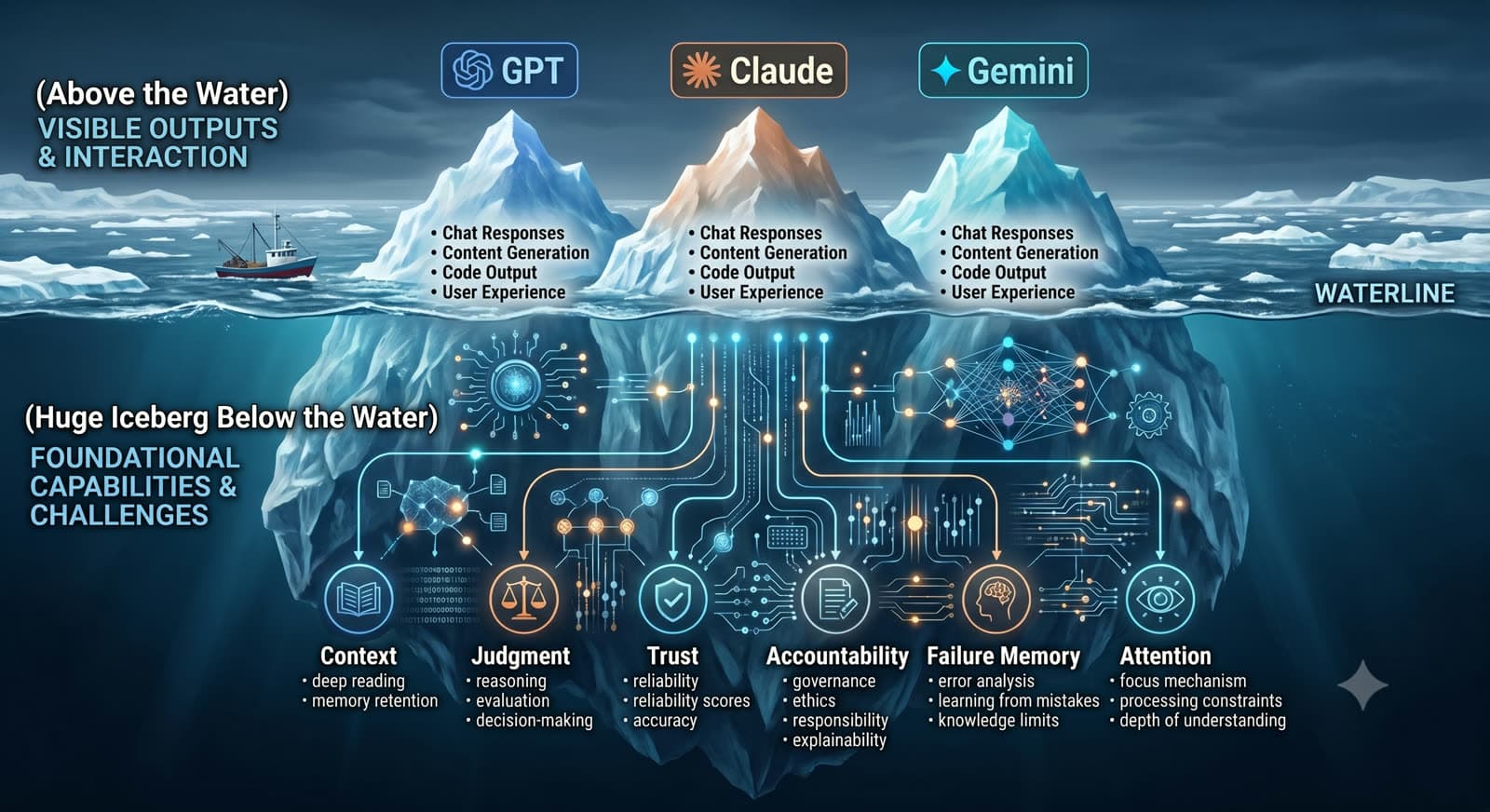
When Models Converge, What Will Organizations Compete On?
A question I've been thinking about lately:
If the best AI models become available to everyone in a few years, what will still differentiate one organization from another?
Some people say data.
Others say compute.
Others point to AI talent.
All of these matter.
But I increasingly believe that AI is not eliminating scarcity. It's redistributing it.
AI is making many things cheaper.
And organizational advantage is shifting toward the things that become more valuable as a result.
Asking the Right Questions
AI made answers cheaper.
So the ability to ask the right questions became more valuable.
As models become increasingly similar, the scarce skill is no longer knowing how to use AI. It's knowing what to ask. Translating ambiguous business challenges into precise, solvable AI tasks is becoming an organizational capability in its own right.
The Value of Validated Failures
AI made experimentation cheaper.
So validated failures became more valuable.
Which use cases actually work? Which ones look promising but fail in production? Which data issues quietly break model performance?
The lessons learned from failed experiments are often more valuable than success stories.
Error Correction as Advantage
AI made execution cheaper.
So error-tolerant processes became more valuable.
The difference between leading and lagging organizations may not be the model itself, but how quickly AI mistakes are detected, corrected, and contained.
Context Over Data
AI made information cheaper.
So context became more valuable.
Future competitive advantage may come less from owning more data and more from understanding customers, workflows, organizational history, and past decisions.
Adaptability Across Models
AI made model switching cheaper.
So cross-model adaptability became more valuable.
Strong organizations won't build capabilities around a single model. They'll build systems that can evolve as technology changes.
Accountability in an AI World
AI made recommendations cheaper.
So accountability became more valuable.
AI can suggest layoffs, investments, hiring decisions, or strategic moves. But organizations and leaders still bear the consequences.
Attention and Deep Judgment
AI made speed cheaper.
So attention allocation and deep judgment became more valuable.
When everyone can generate reports, analyses, and presentations instantly, the scarce skill is no longer producing information. It's knowing what deserves attention—and what should be ignored.
Resisting Over-Automation
AI made automation cheaper.
So AI immunity became more valuable.
Organizations that know which capabilities must remain human, and resist over-automating critical judgment, may ultimately prove more resilient than those pursuing automation at any cost.
Trust as a Premium Signal
AI even made expertise look cheaper.
So trust became more valuable.
In some industries, "a human did this" or "a human stands behind this decision" may once again become a premium signal.
Models Converge, Organizations Won't
Which is why I increasingly believe:
The organizations that win won't necessarily be the ones with the most powerful models.
They'll be the ones with better questions, deeper context, stronger error-correction mechanisms, greater accountability, and the ability to maintain independent judgment while everyone else accelerates.
Models will converge. Organizations won't.
Takeaways
AI is not eliminating scarcity. It's redistributing it.
The scarce skill is no longer producing information. It's knowing what deserves attention—and what should be ignored.
The organizations that win won't necessarily be the ones with the most powerful models.
Was this useful?