What Are World Models? What Are Big Tech Companies Building—and Where Are They Getting Stuck?
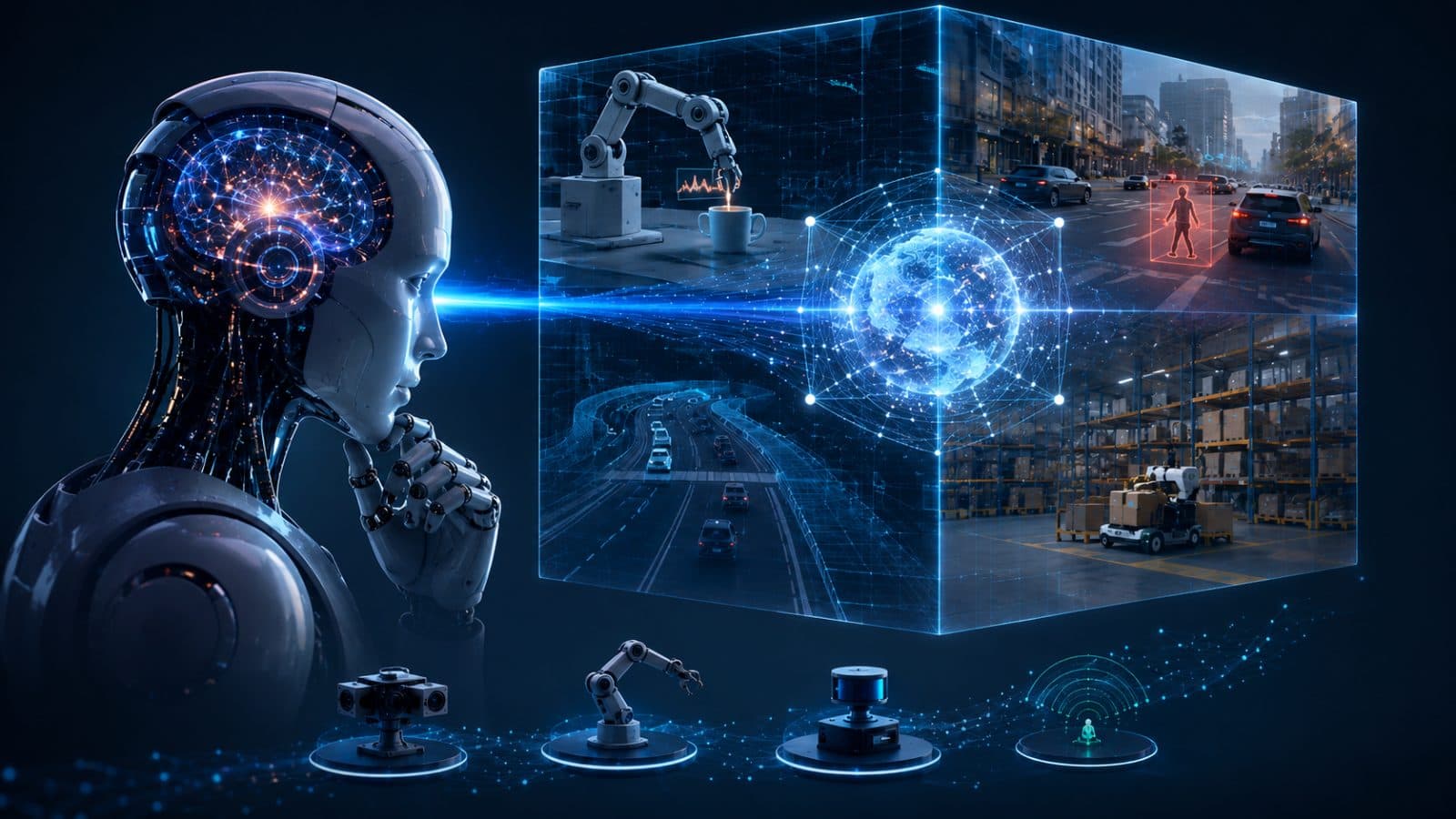
World models aim to help AI understand how the real world works—and anticipate the consequences of its actions before it acts. Put simply, a world model is AI's ability to mentally simulate what might happen next.
What Big Tech Is Building
Big Tech is not building the same thing:
Google DeepMind (Genie 3) — building virtual worlds AI can explore, so it can try, fail, and learn before taking risks in the real world. The hard question: does the world stay consistent over time, or does it only hold up for a few seconds?
NVIDIA (Cosmos) — infrastructure for the robotics industry, generating simulated factories, warehouses, and roads for others to train in. The challenge: proving these environments consistently improve real-world robotic performance, not just that they can be generated at scale.
Meta (V-JEPA 2) — focused on whether AI actually understands the world, predicting how events unfold rather than generating every frame in detail. More efficient, but the reasoning happens inside an abstract representation that's hard to inspect—so it can also be more of a black box.
World Labs (Fei-Fei Li) — giving AI spatial intelligence: understanding where objects are in relation to one another. The challenge: moving from static 3D reconstruction to understanding how a space changes when things move.
Waymo — applying world models directly to safety, simulating dangerous driving situations before vehicles meet them on real roads. The challenge: an extremely low tolerance for failure, and making sure success in simulation doesn't create dangerous overconfidence.
Different paths, one shared ambition: helping AI think before it acts.
The Biggest Barriers
The biggest barriers aren't just compute: 1. High-quality data — continuous, multi-view, time-ordered data, plus action data and feedback on outcomes 2. Physical and causal consistency — visual realism is not the same as world realism 3. Crossing from simulation into reality — what works in simulation may still fail in a real factory or on a real road
How Far Away Are We
How far away are we? World models are getting close to being useful, but still far from truly understanding reality. Today's systems can imagine a few seconds convincingly; as the time horizon extends, physical rules and logic can begin to drift.
The Next Phase of Competition
The next phase of competition won't be about who generates the most realistic video. It will be about crossing three thresholds: from plausible-looking to physically correct, from predicting the next second to planning the next action, and from working in virtual environments to being reliable in the real world.
The real value of world models is not that they make AI better at imagining—it's that they may make AI's imagination progressively closer to reality, and accountable for real-world action.
Takeaways
Different paths, one shared ambition: helping AI think before it acts.
World models are getting close to being useful, but still far from truly understanding reality. Today's systems can imagine a few seconds convincingly; as the time horizon extends, physical rules and logic can begin to drift.
It will be about crossing three thresholds: from plausible-looking to physically correct, from predicting the next second to planning the next action, and from working in virtual environments to being reliable in the real world.
Was this useful?