The AI Era's Survival Question
There's an interesting paradox in today's job market.
On one hand, layoffs continue to make headlines. On the other, companies keep saying they can't find the right talent.
Perhaps the issue isn't a shortage of jobs. It's that employers increasingly want people who are already ready to perform.
The Shift in How Companies Hire
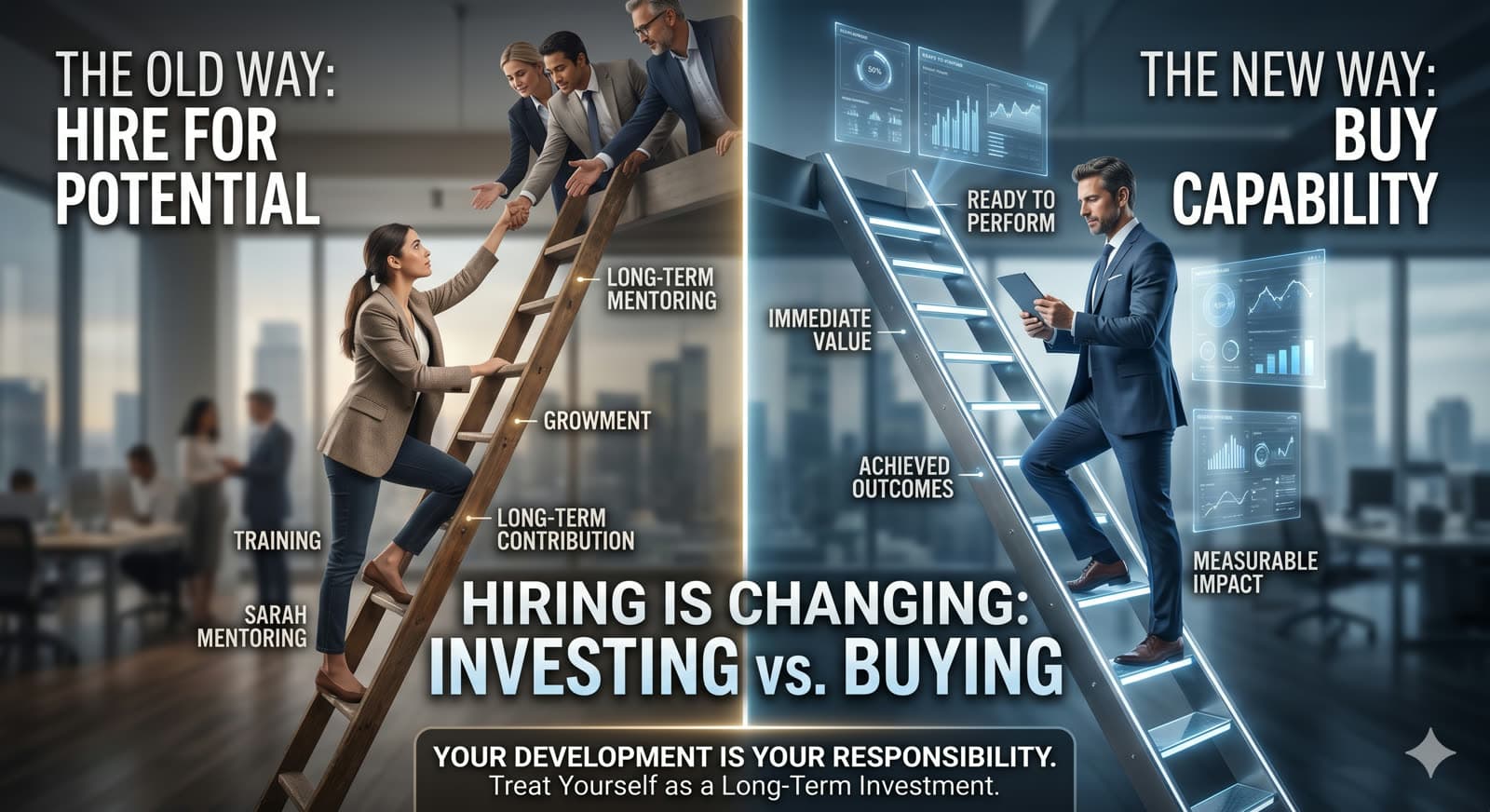
In the past, hiring was often a long-term investment. Companies were willing to hire people with potential, then spend years helping them grow into key contributors.
Today, as organizations become leaner, competition intensifies, and AI accelerates productivity, more employers are asking a different question: Can this person create value quickly?
Companies have not stopped developing talent. But many are investing less in taking people from zero to one, and more in acquiring capabilities that already exist.
For experienced professionals, this may not be a bad thing. But for early-career talent, career switchers, and those still building their skills, the challenge is becoming more apparent.
Why This Matters More Than Layoffs
In many ways, this shift may be more consequential than layoffs themselves.
A layoff is often a one-time shock. A decline in development opportunities can be a slow, ongoing drain on future growth.
Many people believe they are steadily moving up the ladder, without realizing that the ladder itself may no longer be maintained the way it once was.
This isn't about companies failing employees, nor employees failing themselves. It's a reflection of how the environment is changing.
Three Things That Matter Now
In response, I believe three things matter more than ever:
1. Treat yourself as a long-term investment. Don't wait for your employer to define your growth path. Identify a skill area adjacent to your current strengths and invest in it consistently for the next 6–12 months.
2. Build proof, not just tenure. In a market increasingly focused on outcomes, a demonstrated achievement often carries more weight than years of experience. What you have built matters more than how long you have stayed.
3. Regularly calibrate your market value. You don't need to change jobs to understand your position in the market. Conversations, interviews, and job postings can all provide valuable signals about where you stand and what skills are becoming more important.
The Real Risk to Watch
The real risk is not discovering you have gaps. The real risk is finding out how the market sees you only after circumstances force you to look.
Career development is increasingly becoming a personal responsibility.
Continuous learning is no longer just an advantage—it is becoming a necessity.
Takeaways
In many ways, this shift may be more consequential than layoffs themselves.
Many people believe they are steadily moving up the ladder, without realizing that the ladder itself may no longer be maintained the way it once was.
The real risk is finding out how the market sees you only after circumstances force you to look.
Was this useful?