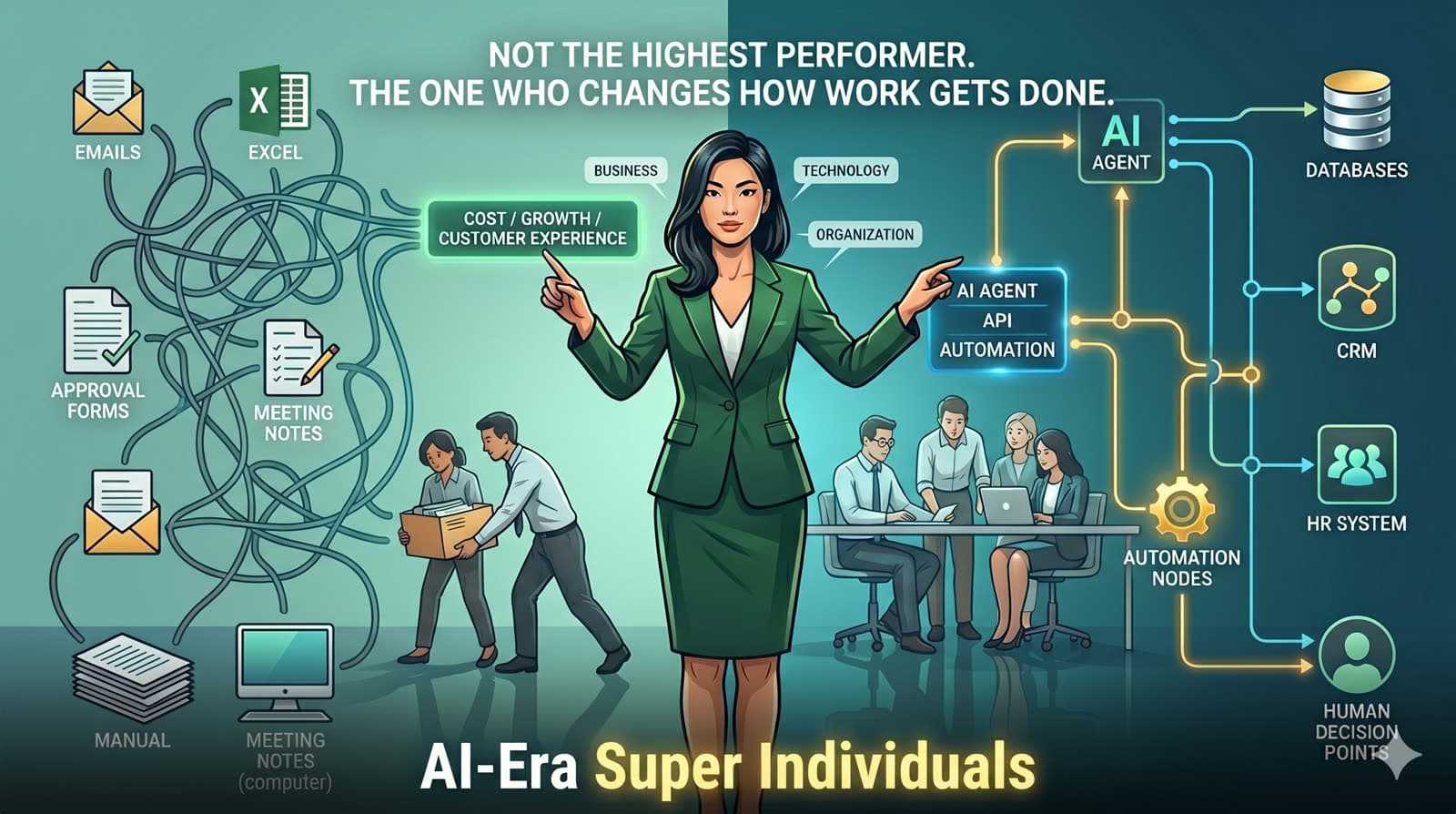
Stop Identifying AI-Era Super Individuals Only by Performance Rankings
In the AI era, many organizations may misidentify their "super individuals." They assume these are the people with the best performance, highest output, fastest tool adoption, or strongest prompt-writing skills. But this definition is becoming outdated.
What a True Super Individual Is
A true super individual is not someone who can do the work of ten people. It is someone who can change the way ten people work. Their value is not in replacing the organization, but in amplifying it.
You can identify them by observing how they respond to an inefficient process. An average employee may say, "This step can be made faster with AI." A super individual goes further: Why does this process still require so much manual handoff? Which decisions must remain human-led? Which steps can be handled by an AI agent? Can we reduce a five-day process to five hours? They are not just improving one task. They are redesigning the workflow itself.
A Concrete Example
For example, an HR professional may not only use AI to write job descriptions. She may redesign the entire recruitment workflow: how hiring needs are clarified, how candidates are screened, how interview feedback is structured, and how offer risks are flagged. She is not changing one JD. She is changing a workflow.
The Three Languages They Speak
Another overlooked trait of super individuals is that they can translate between three languages: Business language: cost, growth, customer experience. Technical language: models, APIs, automation flows. Organizational language: processes, roles, collaboration, incentives.
Five Behavioral Signals to Watch
So how do you identify them? Look beyond title. Look for five behavioral signals: ① Do they proactively redesign workflows instead of waiting for the company to train them on tools? ② Can they turn a vague goal like "we want to use AI to improve efficiency" into clear tasks, data inputs, process steps, owners, and success metrics? ③ Have they driven cross-functional change without formal authority? ④ After a project, do they leave behind SOPs, prompt templates, agent configurations, or training materials instead of just a polished demo? ⑤ After they leave, has the team's way of working changed? The last one is the real dividing line. A super individual is not someone who is "irreplaceable." A super individual is someone who can continuously replicate high performance. They may not sit in the AI department. They may not even be in a technical role. They may be hidden in HR, sales, operations, or supply chain, quietly changing how people around them work.
The Harder Question Ahead
The next time you identify high-potential talent, look less at title and more at this question: Who is changing the workflow? Identifying them is only the first step.
The harder question is: how can organizations stop using them as "firefighters" and start turning their capabilities into a system? To be continued.
Takeaways
Another overlooked trait of super individuals is that they can translate between three languages: Business language: cost, growth, customer experience.
A super individual is not someone who is "irreplaceable." A super individual is someone who can continuously replicate high performance.
Was this useful?