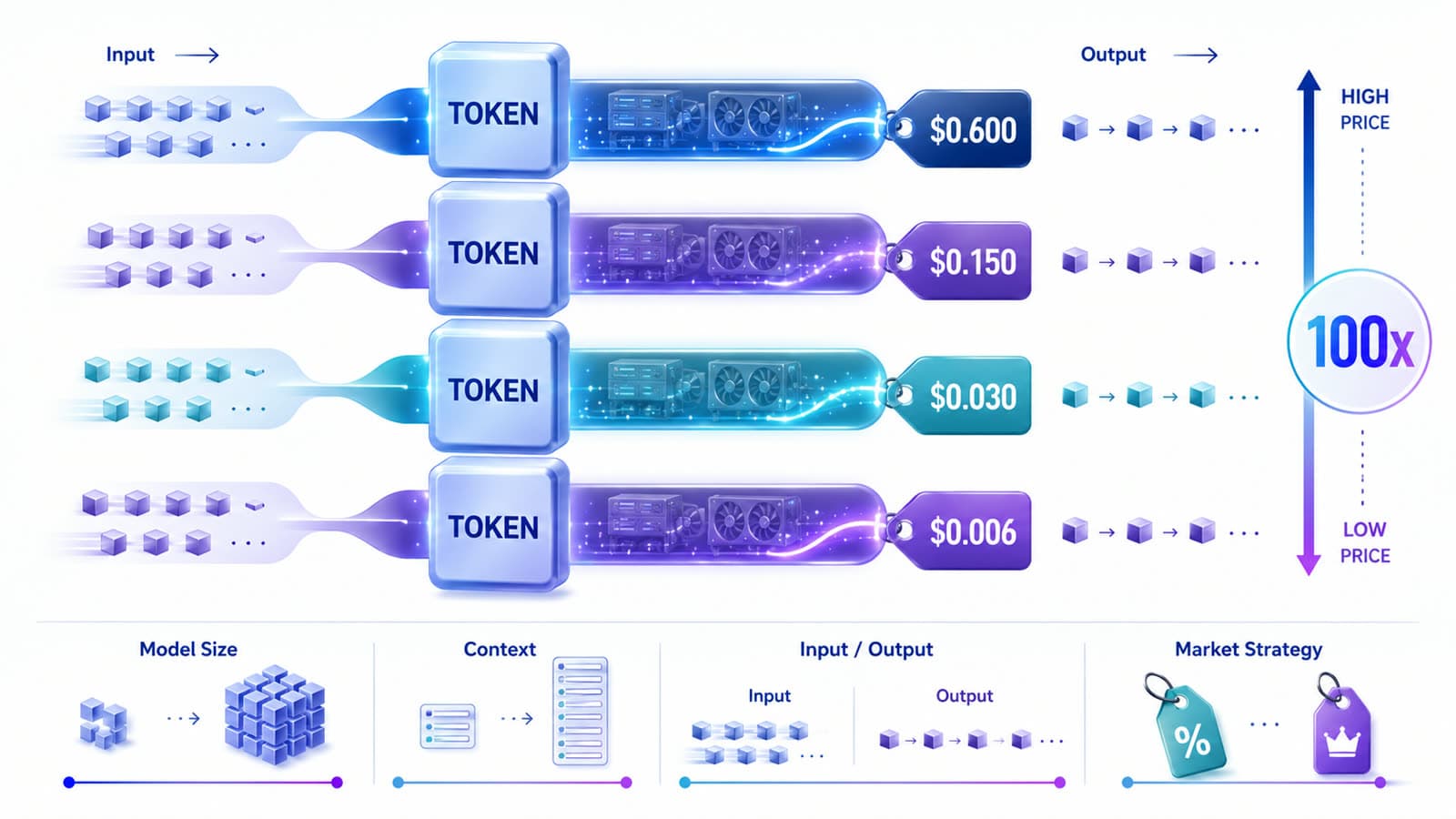
Same AI, Why Can Prices Differ by 100x?
Open the pricing pages of different AI providers and you'll notice something strange: for processing the same amount of text, some models charge tens or even hundreds of times more than others. How is that even possible?
The Unit Behind AI Billing
To understand this, you need to know one word: Token.
A token is the smallest unit an AI uses to process text. Before doing anything with your message, the AI breaks it down into small fragments called tokens. In English, roughly one word equals one token. All AI companies use tokens as their billing unit — because tokens directly correspond to actual GPU computation, making them the fairest measure of what the AI actually does.
Here's an intuitive reference point: 1 million tokens is roughly equivalent to all seven Harry Potter books combined. Processing that volume of text can cost just a few cents on a cheap model, or tens of dollars on a premium one — in extreme cases, such as free/heavily subsidized services versus enterprise-grade offerings, the gap can reach 100x or more.
What Drives Token Price
So how exactly is the price of a token determined?
Four key variables drive it:
① Model size. More parameters mean more computation per token, which means higher cost. This is why, within the same company, flagship models are often 10x more expensive than their lightweight counterparts.
② Input vs. output asymmetry. Most providers charge significantly more for output tokens than input tokens — commonly 2–4x, sometimes even higher. The reason: reading your input can be processed in parallel, but generating a response requires producing one token at a time, step by step. Think of it like how typing always takes longer than reading.
③ Context window length. In the standard Transformer architecture, the attention mechanism scales roughly quadratically with context length — meaning the longer the conversation the model can "remember," the more computation it requires, and the higher the price.
④ Market strategy. This is the part people often miss — pricing isn't just a reflection of cost, it's a competitive weapon. Google and Meta have both priced models below cost to capture market share. When a model seems suspiciously cheap, it often means a tech giant is subsidizing you.
Is the Price Difference Worth It?
Not always. Premium models genuinely excel at complex reasoning and long document analysis — but if you're doing simple text classification or customer service automation, the cheapest model is often more than enough. Paying more just means paying for capability you'll never use.
Think of it like shipping: you wouldn't use overnight express for a package that doesn't need to arrive until next week.
Takeaways
When a model seems suspiciously cheap, it often means a tech giant is subsidizing you.
Paying more just means paying for capability you'll never use.
Was this useful?