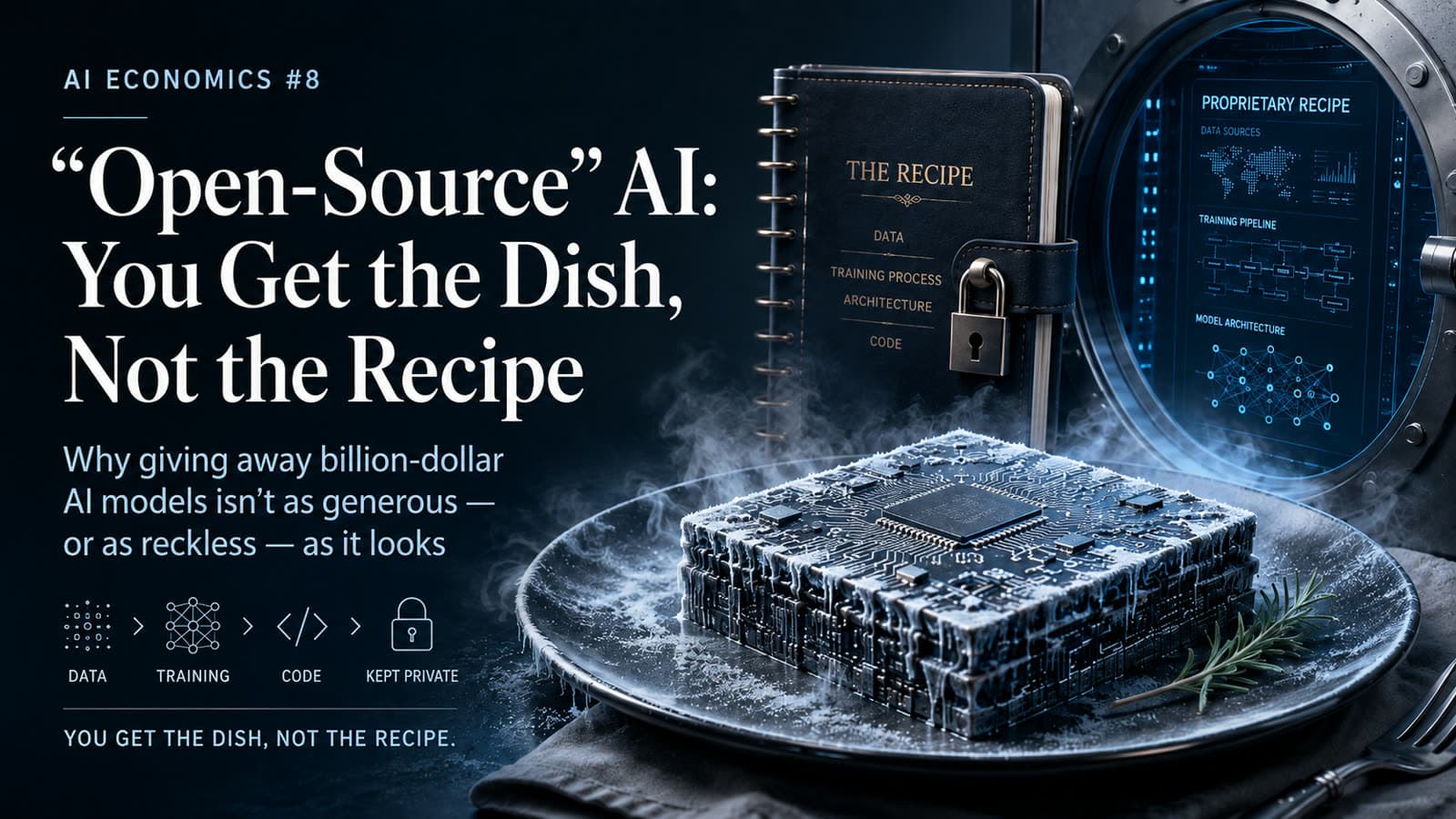
Open-Source AI: You Get the Dish, Not the Recipe
Most "open-source" AI models aren't actually open source. They're "open weight" — and that distinction explains why giving away billion-dollar models isn't as generous (or as reckless) as it looks.
(Note: I use "open source" in the loose industry sense here; most of these releases don't meet the OSI definition.)
What Open Weight Actually Means
YOU GET THE DISH, NOT THE RECIPE
A model's capabilities live in billions of trained parameters — the weights. Open weight means putting that file online for anyone to download, run, fine-tune, and commercialize.
True open source would also include the training code, training data, data curation methods, and process details. Almost nobody releases those.
Think of it as a frozen meal: reheat it, add ingredients, serve it however you like. But without the recipe, you can't recreate it from scratch.
Two implications: → The crown jewels stay home. The data recipe and training craft — what enables iteration — never leave the building. → You're always giving away yesterday's dish. Once the next-gen model is trained, the marginal cost of releasing the old one drops sharply.
Who Actually Uses Open Models
WHO ACTUALLY EATS THE FROZEN MEAL? THREE LAYERS
- Enterprises: self-hosted deployment, so data never leaves the company. For banks, hospitals, and law firms with compliance needs, open models are increasingly the default answer.
- Developers: cheap building blocks. Download from Hugging Face, run locally via vLLM or Ollama, or use third-party inference platforms at a fraction of closed-API prices.
- Consumers: invisible coverage. Many apps quietly run Qwen or Llama in the backend; on-device translation and voice assistants are often compressed open models.
The result: the whole world's kitchens cook to your taste — while the better next-gen recipe stays in your hands.
Closed-Source Pricing Power Loosens
THE SHOCKWAVE: CLOSED-SOURCE PRICING POWER IS LOOSENING
When "good-enough intelligence" costs a fraction of the price, closed APIs hit a visible ceiling. Companies are moving from token-maxxing to strict ROI reviews — public reports suggest Uber and Microsoft now restrict pricey AI tools, and Coinbase reportedly cut internal AI spend substantially by switching to open models.
Palantir's Alex Karp calls token billing a "wealth tax" on enterprises. Self-serving? Sure — Palantir sells the alternative. But the underlying trend is real: open models force closed labs to keep proving the frontier premium is worth it.
Where Value Will Ultimately Settle
THE REAL BET
Closed labs bet a recipe lead keeps commanding token revenue. Open-weight players bet the giveaway buys something more valuable — ecosystems, chip sales, or a rival's eroding moat. Deployment vendors bet what matters most is whose turf the AI runs on.
Where will AI's value ultimately settle — models, compute, ecosystems, or deployment? No answer yet. One certainty: that free frozen meal has already reshaped the pricing of the entire menu.
Takeaways
The result: the whole world's kitchens cook to your taste — while the better next-gen recipe stays in your hands.
open models force closed labs to keep proving the frontier premium is worth it.
that free frozen meal has already reshaped the pricing of the entire menu.
Was this useful?