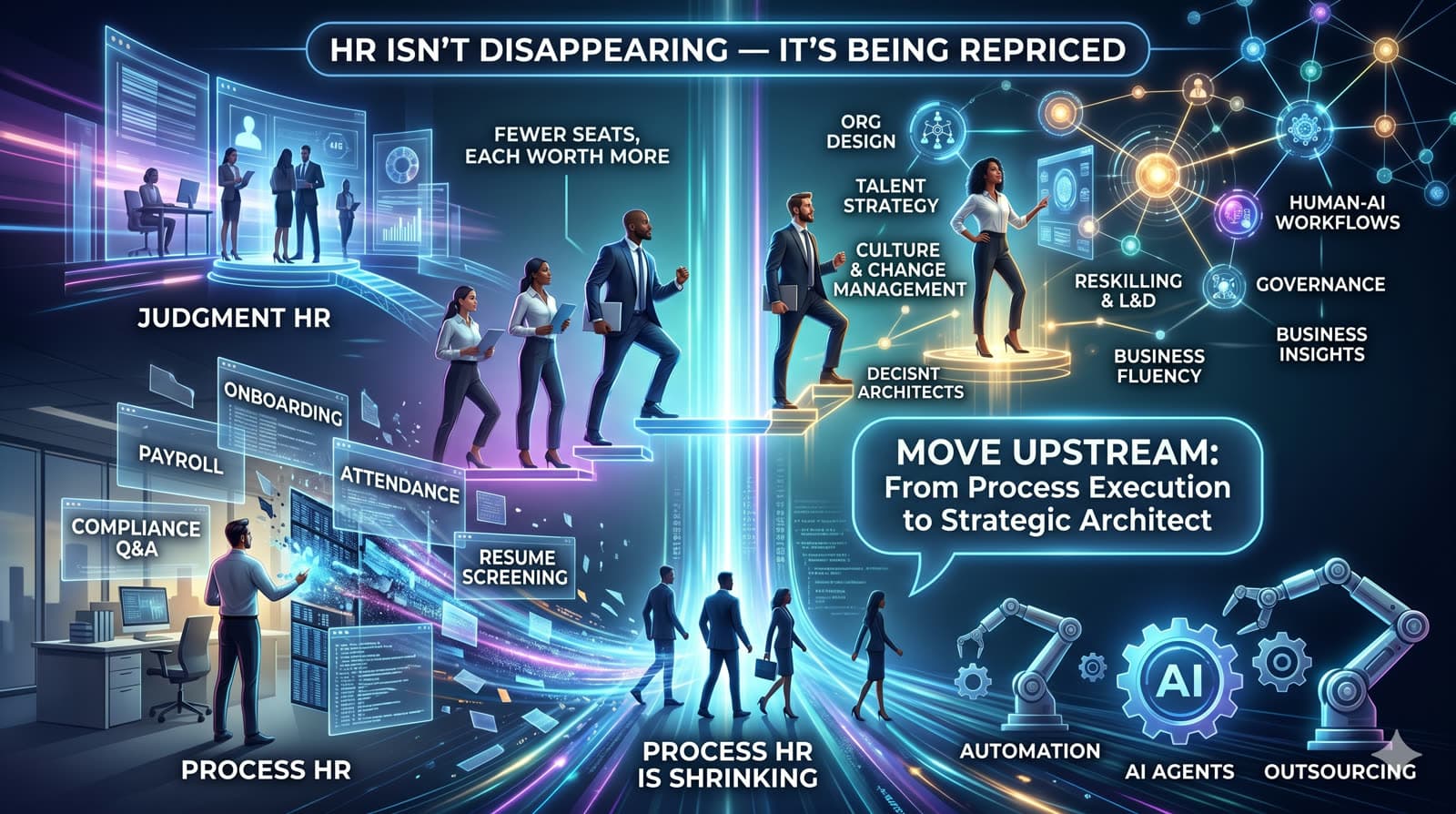
HR Isn't Disappearing in the AI Era — It's Being Repriced
People keep asking me: with AI here, does HR even survive?
My take: it won't disappear, but it will split sharply — and the total number of roles will shrink.
Two Layers of HR
It helps to see HR as two layers.
One layer is process HR: payroll, benefits, resume screening, onboarding, attendance, basic compliance Q&A. This layer is caught in a three-way squeeze — automation, leaner orgs, and outsourcing — and it's shrinking fastest.
The other layer is judgment HR: org design, talent strategy, culture, change management, and the human side of rolling out AI. As companies become a blend of "small core + outsourcing + AI agents," someone still has to orchestrate talent, design the organization, manage resistance, and handle governance. Those problems don't vanish — they get scarcer and more valuable.
Fewer Seats, New Shapes
So the likely outcome isn't extinction. It's this: fewer seats, but each seat worth more. New shapes are already appearing — fractional HR, People Ops embedded inside the business, "talent architects," even roles built around managing AI agents as a workforce.
How to Position Yourself
Against this backdrop, here's how I'd think about it: escape what's easiest to replace, move toward what's hardest.
- Move upstream. Shift from executing processes to org design and talent strategy. The more standardized the task, the sooner it's automated.
- Be the person who uses AI, not the one out-competed by it. Whoever can design human–machine workflows becomes the architect of the new way of working.
- Close two gaps: business fluency and data. That's your ticket from "support function" to "decision partner."
- Bet on what's rising: org design, hybrid-team culture, reskilling and L&D, and the human side of AI adoption.
- Seriously consider going solo — fractional HR or consulting across several small companies.
The Logic Underneath
The logic underneath is simple: wherever there's a new, hard-to-automate, scalable pain point, there's demand.
In one line: HR isn't dying. Process HR is dying, and judgment HR is appreciating.
The real risk isn't AI itself — it's letting yourself stay stuck in the part of the job that's easiest to automate.
Takeaways
Fewer seats, but each seat worth more.
Whoever can design human–machine workflows becomes the architect of the new way of working.
The real risk isn't AI itself — it's letting yourself stay stuck in the part of the job that's easiest to automate.
Was this useful?