How Do We Actually Decide Whether a Company Is a Global AI Leader?
Lately, I've been reading a lot of discussions about AI companies, and I keep coming back to a question that sounds deceptively simple: How do we actually decide whether a company qualifies as a top-tier global AI company?
A new model gets released. It beats GPT, Claude, or Gemini on a benchmark, and almost immediately, people start saying:
"Number one in the world."
"It crushes OpenAI."
"The AI landscape is about to be rewritten."
On the other side, when a company's valuation surges or its market capitalization hits a record high, it is quickly described as "the biggest winner of the AI era."
The more of these discussions I see, the more I feel that our judgment of whether an AI company is truly strong is increasingly being driven by a handful of simple numbers.
If a model ranks first on a benchmark, does that make its company the world's leading AI company?
If a company has the largest market capitalization, does that mean it has the strongest AI capabilities?
This may be one of the cognitive traps created by social media today: the more complex an industry becomes, the more tempting it is to compress it into a single number.
But one number rarely explains the true strength of a company.
The Best Model Does Not Necessarily Mean the Best Company
Today, one of the most common ways to evaluate an AI company is to look at model rankings. And that makes sense. For companies such as OpenAI, Anthropic, Google DeepMind, xAI, and DeepSeek, model capability itself is a core source of competitiveness.
How strong is the reasoning? How good is the coding performance? What about multimodal capabilities? Agentic capabilities? Cost? All of these matter.
But there is a fundamental problem: a model leaderboard tells us how strong a particular model is at a particular point in time. It does not tell us how strong the company behind it is as a whole. Those are two very different questions.
Take NVIDIA as the simplest example. If we evaluated AI companies purely through chatbot leaderboards, NVIDIA would barely enter the conversation. Yet it would be difficult to argue that NVIDIA is not one of the most important AI companies in the world. Why? Because it controls a different layer of the stack: the computing infrastructure behind AI.
The same logic applies to AWS. AWS does not have a household-name chatbot comparable to ChatGPT. But when enterprises actually deploy AI, much of the cloud infrastructure, data, storage, security, access control, model hosting, and computing resources they need may sit on AWS.
Model capability may determine whether a company gets a seat at the AI table. But whether it can stay there over the long term depends on far more than the model itself.
So What Should We Actually Look At?
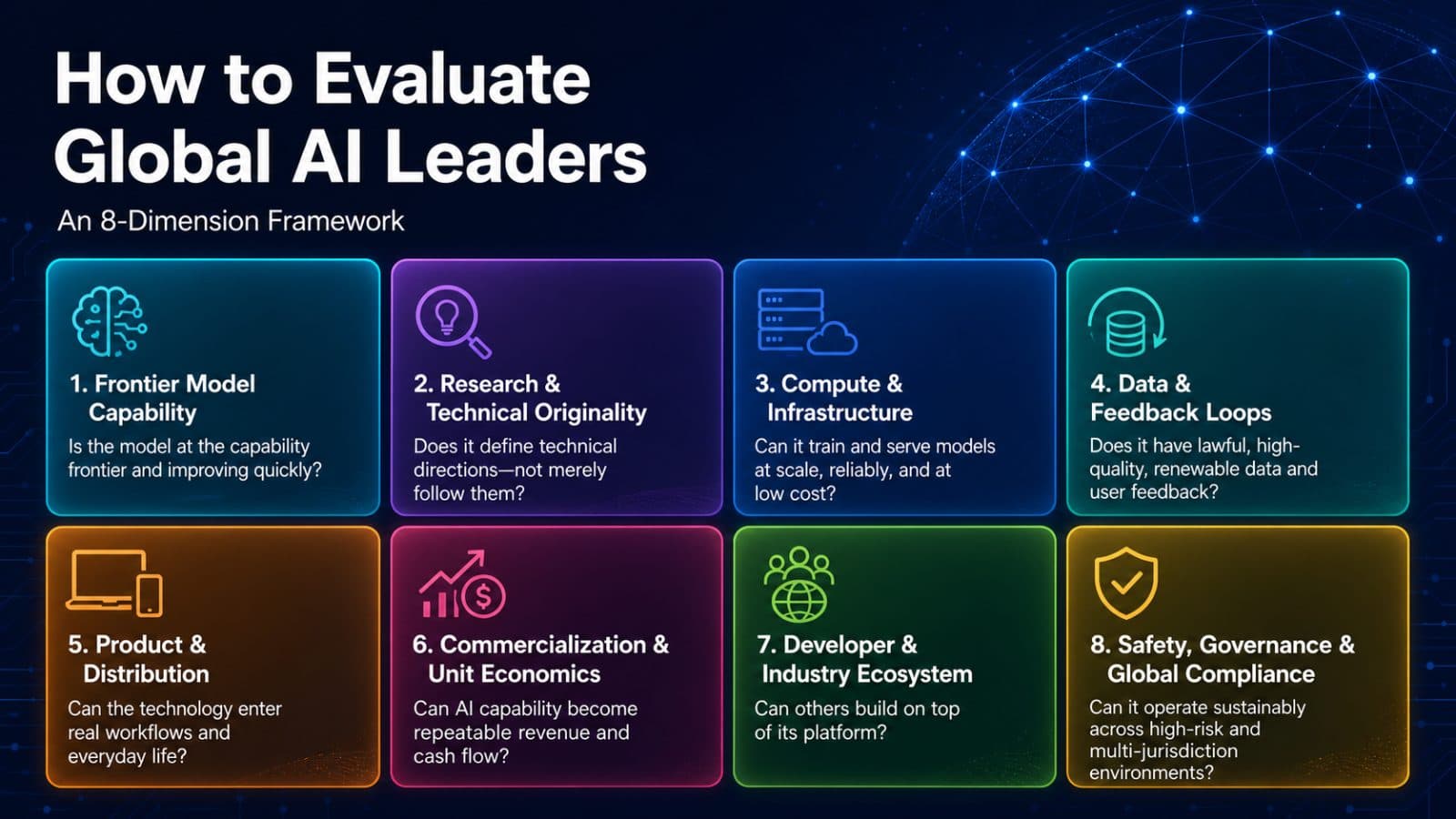
If model benchmarks alone are not enough, how should we evaluate whether a company is truly a global AI leader? I think there are at least eight dimensions worth paying attention to:
Model capability, research originality, compute and infrastructure, data and feedback loops, products and distribution, commercialization, developer and industry ecosystems, and safety and global governance capabilities.
In other words, competition among the world's leading AI companies can no longer be explained by a single LLM leaderboard.
It looks much more like a long value chain:
Chips / Compute → Cloud & Training Platforms → Foundation Models → Developer Tools → Product Distribution → Industry Applications
Different companies occupy different positions along this chain.
This is also why companies such as Google, Microsoft/OpenAI, NVIDIA, AWS, Meta, Anthropic, Alibaba, and ByteDance are difficult to compare on a single "model leaderboard."
What makes Google truly formidable is not just Gemini. Behind Gemini are TPU, Google Cloud, Search, Android, Chrome, Workspace, and YouTube. If Gemini's capabilities ultimately become embedded across search, browsers, smartphones, productivity software, and cloud services, Google is not simply acquiring users for another chatbot. It is embedding AI into the daily digital lives of billions of people.
Microsoft is similar. Its AI advantage is not simply about whether it has access to the strongest model. It also has Azure, GitHub, Windows, Microsoft 365, Teams, and enormous relationships with enterprise customers around the world.
Then there is Meta. Its models may not rank first after every release, but Meta controls global-scale distribution through WhatsApp, Instagram, and Facebook.
Alibaba represents another interesting case. If we focus only on where Qwen ranks on a particular model leaderboard, we may easily underestimate Alibaba's broader competitive position. Behind Qwen are Alibaba Cloud, enterprise customers, a developer ecosystem, and an infrastructure stack that spans model training, deployment, and enterprise applications. So the more important question is not simply whether Qwen can outperform GPT or Claude. It is whether Alibaba can successfully connect **models + cloud + developers + enterprise applications** into a self-reinforcing AI ecosystem.
ByteDance represents yet another path. Doubao's model capabilities certainly matter, but ByteDance also possesses something distinctive: enormous product and content ecosystems through Douyin, TikTok, CapCut, and other platforms, combined with years of expertise in recommendation systems, user behavior, and consumer product design. If AI increasingly becomes embedded in content creation, search, recommendations, advertising, e-commerce, and video production, then the model itself is only one layer. The real scale advantage may come from connecting that model to existing product distribution.
So when evaluating these companies, perhaps the more important question is no longer: "Who has the highest model score?"
It is: "Which critical nodes of the AI value chain does this company control?"
Market Capitalization Cannot Answer This Question Either
Another metric that can easily shape our judgment is market capitalization. Market cap obviously matters. Capital markets incorporate expectations around revenue, profit, growth, competitive moats, and future potential. But "the world's most valuable technology company" and "the company with the strongest AI capabilities" are still not the same thing.
Especially in AI, a company's value may come from chips, cloud computing, advertising, enterprise software, or consumer products.
Market capitalization tells us how much the market is willing to value a company. But by itself, it cannot tell us: what irreplaceable capability does this company actually control in the AI era? The same applies to funding, valuation, user numbers, and even media attention. Each answers only part of the question. This is why I have become increasingly cautious about overly simple conclusions such as: "Company A is now valued higher than Company B, so it has surpassed it." "This model ranks first on a benchmark, so the company is now number one globally." "This AI app's downloads are exploding, so the business model has already been proven."
These statements may not be entirely wrong. But they often take **one metric and ask it to explain the entire world.**
What Really Matters Is System-Level Capability
When I put all these dimensions together, I think what truly defines a top-tier global AI company is something broader: system-level capability.
Can it continuously develop frontier models?
Does it have enough compute to support the next generation of models?
Does it have proprietary data and strong feedback loops?
Can it turn models into real products?
Can it reach hundreds of millions of consumers—or large numbers of enterprise customers?
Do developers want to build on its platform?
Are enterprises willing to keep paying for its products?
And as AI moves deeper into finance, healthcare, government, and large enterprises, can the company handle security, privacy, auditing, copyright, and regulatory requirements across different countries?
Together, these capabilities form the foundation of long-term AI competitiveness.
You can even think of them as a flywheel:
Better models → More users and developers → More data, feedback, and revenue → More compute and R&D investment → Better models
The strongest companies are not necessarily those that dominate one individual layer. They are the ones capable of keeping this flywheel turning.
This is also why a **top-tier AI lab** and a **top-tier AI company** are not necessarily the same thing.
A lab with dozens or hundreds of people may absolutely be capable of training the world's best model at a particular point in time. That is an extraordinary technological achievement. But becoming a truly global AI giant requires much more: capital, compute, infrastructure, products, distribution, commercialization, ecosystems, and governance.
Building the smartest model and building the strongest AI company are fundamentally two different competitions.
Why Rankings Have a Short Shelf Life
By this point, I find the question "Who are the world's top five AI companies in 2026?" less interesting than I used to. Because the answer will inevitably change. The model ranked number one today may be surpassed next month. The hottest product today may disappear two years from now. A company celebrated by capital markets today may eventually go through another cycle.
The faster AI develops, the shorter the shelf life of any ranking becomes. But one thing has a much longer shelf life: your framework for making judgments.
Social media naturally favors simple narratives:
Number one.
Largest market cap.
Highest valuation.
Fastest growth.
"Crushing the competition."
"Redefining the industry."
These phrases attract attention precisely because they simplify complexity. But the real business world is rarely that simple.
So whenever I see an AI company suddenly explode in popularity, I increasingly find myself asking a different set of questions:
What core technology does it actually control?
Which critical node of the value chain does it occupy?
Where do its users and distribution come from?
Can its business model sustain itself?
Why can't competitors easily replicate what it has built?
And if the capability gap between models continues to narrow, what advantage will it still have left?
These questions may not give us the satisfying answer of "number three in the world."
But they can bring us much closer to understanding what a company is actually worth.
In an era of ever more information and ever faster conclusions, perhaps what is truly scarce is no longer knowing who ranks first—but having a framework for judgment that is not so easily driven by leaderboards, valuations, and whatever happens to be trending today.
Takeaways
Model capability may determine whether a company gets a seat at the AI table. But whether it can stay there over the long term depends on far more than the model itself.
"the world's most valuable technology company" and "the company with the strongest AI capabilities" are still not the same thing.
Especially in AI, a company's value may come from chips, cloud computing, advertising, enterprise software, or consumer products.
When I put all these dimensions together, I think what truly defines a top-tier global AI company is something broader: system-level capability.
Better models → More users and developers → More data, feedback, and revenue → More compute and R&D investment → Better models
But one thing has a much longer shelf life: your framework for making judgments.
In an era of ever more information and ever faster conclusions, perhaps what is truly scarce is no longer knowing who ranks first—but having a framework for judgment that is not so easily driven by leaderboards, valuations, and whatever happens to be trending today.
Was this useful?