From SEO to GEO: In the AI Traffic Wars, Who's Selling the Shovels?
A conversation with a friend got me thinking about the wave of founders building GEO (Generative Engine Optimization) businesses. Some call it the 2005 of SEO all over again.
My take: the direction is probably right — but this market has three layers, and most of the attention is going to the one with the lowest barrier to entry.
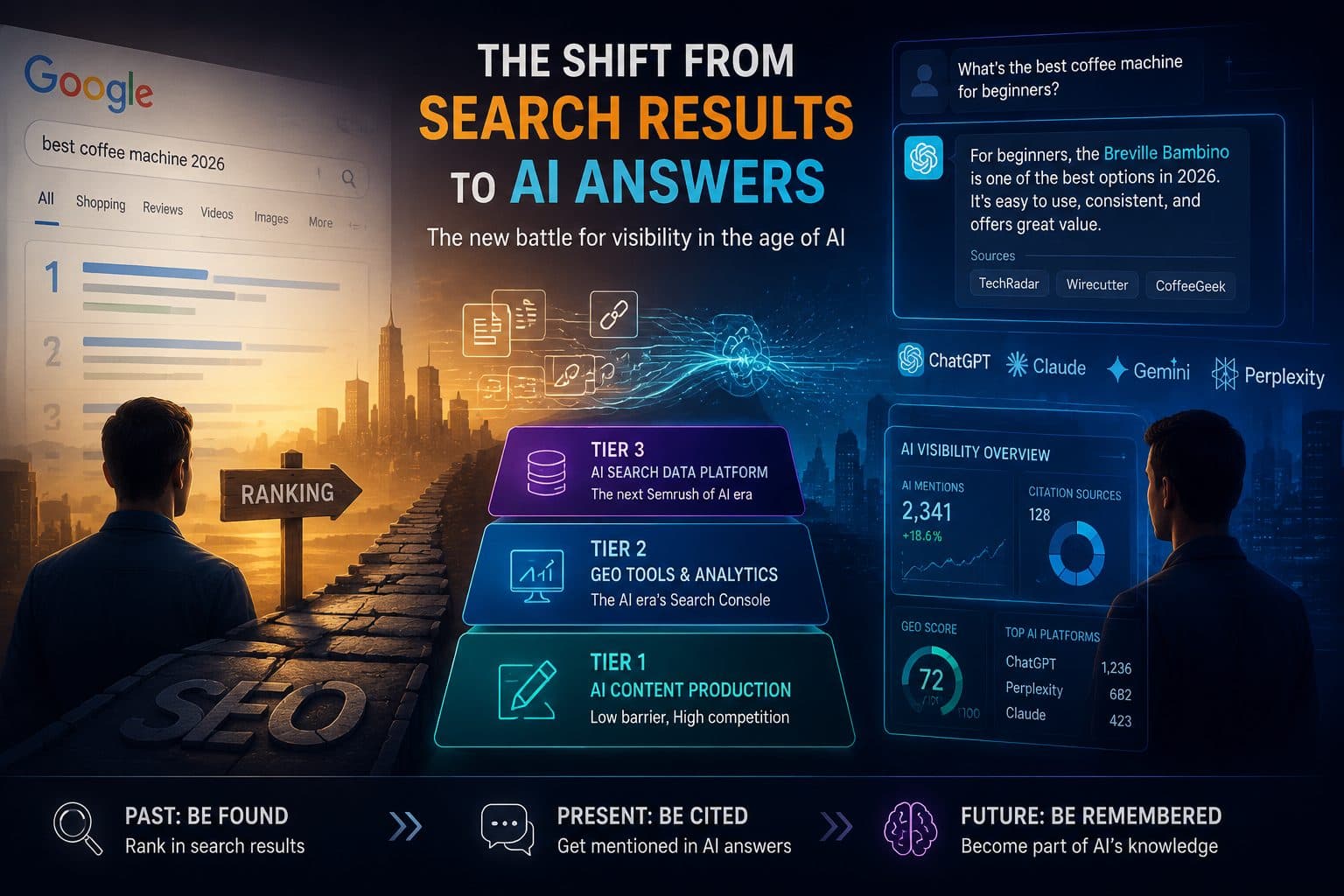
The Shift From Search to AI Answers
For twenty years, companies asked: "Can people find me on Google?" The next decade's question: "Does ChatGPT recommend me? Does Claude mention me?"
When users stop searching and start asking, the traffic gateway shifts from a results page to a single AI answer. Whoever appears in that answer owns the new page one.
Layer 1: AI Content Services
Layer 1: AI content services — lowest barrier "We do GEO for you" usually means AI + content marketing: rewriting "Best Coffee Machine 2026" into the questions people will actually ask AI. Totally viable business. The challenge: when everyone uses the same models, deliverables converge fast. Differentiation will come from industry depth and quality — not from the AI itself.
Layer 2: GEO Tooling
Layer 2: GEO tooling — the biggest opportunity Companies have a real, unanswered anxiety: How does AI describe me? Why is my competitor cited and not me? There's no "Search Console for AI" yet. So we're seeing brand visibility trackers, citation monitors, and early "AI Authority Scores." In every search paradigm shift, the first money goes to the people selling dashboards. In a gold rush, sell shovels.
Layer 3: AI Search Data Platforms
Layer 3: AI search data platforms — highest barrier Semrush and Ahrefs got rich because Google wouldn't share its data, so they built their own. The AI-era equivalent: running hundreds of thousands of prompts daily across GPT, Claude, Gemini, and Perplexity to build the world's largest "AI recommendation database." Expensive to build. Nearly impossible to displace once built.
US vs. China: Two Different Games
The US and China are playing entirely different games:
US: tech-first, selling data. Analytics, citation tracking, prompt databases — sold to B2B SaaS at $hundreds–thousands/month. China: operations-first, selling execution. AI-generated content across Zhihu, Xiaohongshu, WeChat — an upgraded version of the old SEO agency.
Not a capability gap — an ecosystem gap. US traffic genuinely flows through ChatGPT and Perplexity; China's AI answers are still deeply tied to content platforms. The US is building the infrastructure layer; China is winning the operations layer.
Three Closing Thoughts
Three closing thoughts:
- Those writing with AI are working jobs. Those monitoring AI are building platforms. Those recording AI are mining gold.
- GEO isn't the new SEO — it's the third great transfer of traffic power: portals → search engines → large models.
- The real question isn't "Will AI recommend me?" It's "When AI becomes everyone's first gateway, do you exist in its worldview?"
Search rewarded ranking. AI rewards being remembered.
What's your take?
Takeaways
Differentiation will come from industry depth and quality — not from the AI itself.
Expensive to build. Nearly impossible to displace once built.
Those writing with AI are working jobs. Those monitoring AI are building platforms. Those recording AI are mining gold.
Was this useful?