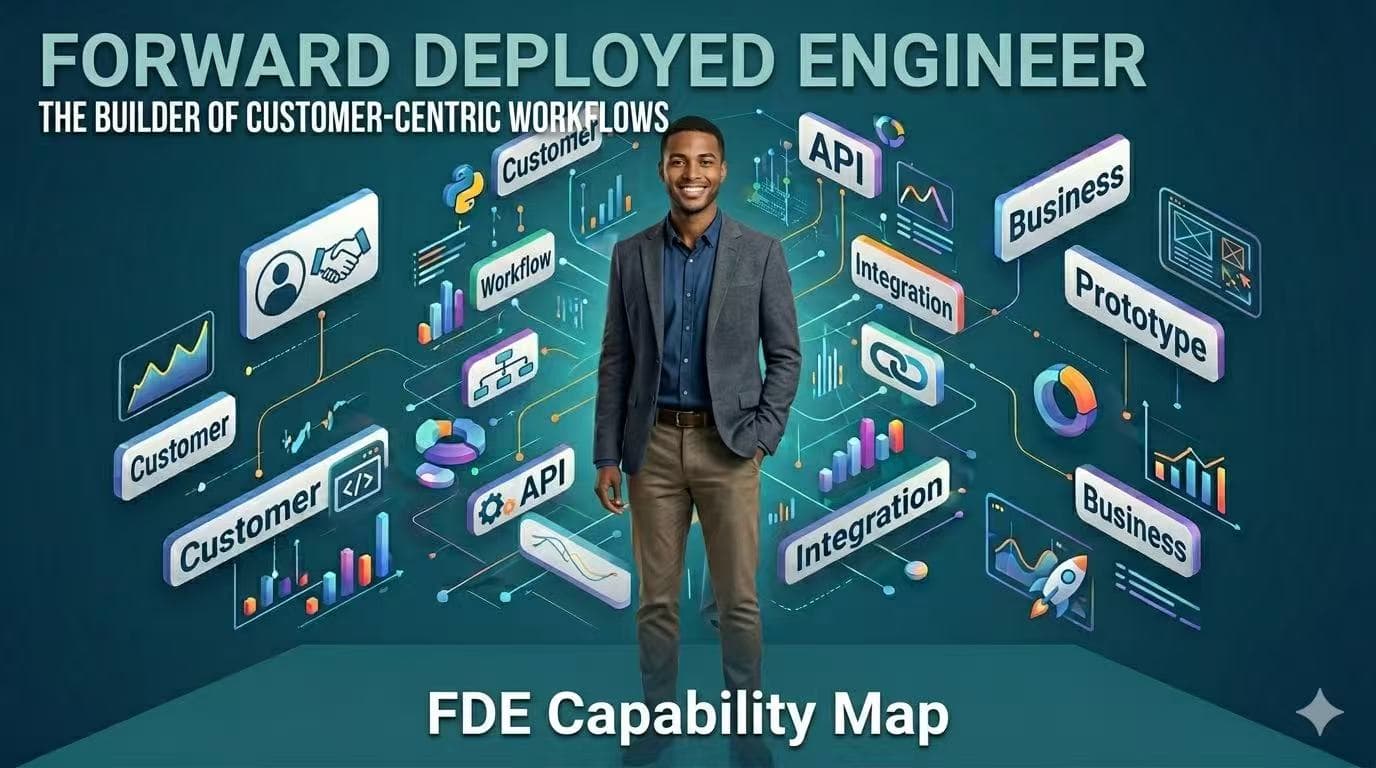
Forward Deployed Engineer
Each episode breaks down one emerging AI-era role. Understand what it is, who it’s for, and how to break into it.
What Is an FDE?
Over the past year, one role has appeared everywhere: Forward Deployed Engineer (FDE). Palantir has them. OpenAI has them. Anthropic has them. More and more AI startups are hiring them too.
What's interesting is that FDEs don't fit the traditional definition of either an engineer or a consultant. They're a blend of both. A simple way to think about it: If AI Engineers build AI capabilities, FDEs turn those capabilities into solutions that customers can actually use.
AI in Real-World Workflows
Imagine a bank purchasing an AI system to automate customer service operations. The model already exists. The technology already works. But the real questions begin afterward: Where is the customer data? How do existing workflows operate? Which steps require human approval? What regulatory requirements must be respected? This is where FDEs come in. They work closely with customers, understand how the business operates, and integrate AI into real-world workflows.
Unlike traditional consultants, FDEs don't just recommend solutions—they build them. They write code, integrate systems, develop prototypes, and help customers get value from AI faster. Companies don't buy models. They buy outcomes. FDEs bridge the gap between the two.
Skills That Matter Most
*So what skills matter most?* Technical capability is the foundation. FDEs need to understand APIs, system architecture, data flows, and AI products. Business understanding is equally important. They must quickly learn how an industry works and where AI can create value. Communication is the differentiator. The best FDEs can discuss architecture with engineers and business impact with executives.
The Real Barrier to Entry
*What's the real barrier to entry?* Coding is the ticket in. The real challenge is solving ambiguous problems. Customer requirements change. Data is incomplete. Workflows evolve. There is rarely a perfect answer. The value of an FDE lies in finding a path forward when the answer isn't obvious.
Who Transitions In Successfully
*Who transitions into this role most successfully?* Solution consultants, implementation specialists, technical consultants, and tech product managers already operate between technology and business. Customer-facing software engineers are also well positioned because they combine technical depth with real-world problem solving.
In the past, the most valuable people built technology. In the future, some of the most valuable people may be those who make technology create value. That's exactly where FDEs thrive.
Next: AI Product Manager - As AI becomes more capable, will product managers become less important—or more important than ever?
Takeaways
Companies don't buy models. They buy outcomes. FDEs bridge the gap between the two.
The value of an FDE lies in finding a path forward when the answer isn't obvious.
In the past, the most valuable people built technology. In the future, some of the most valuable people may be those who make technology create value. That's exactly where FDEs thrive.
Was this useful?