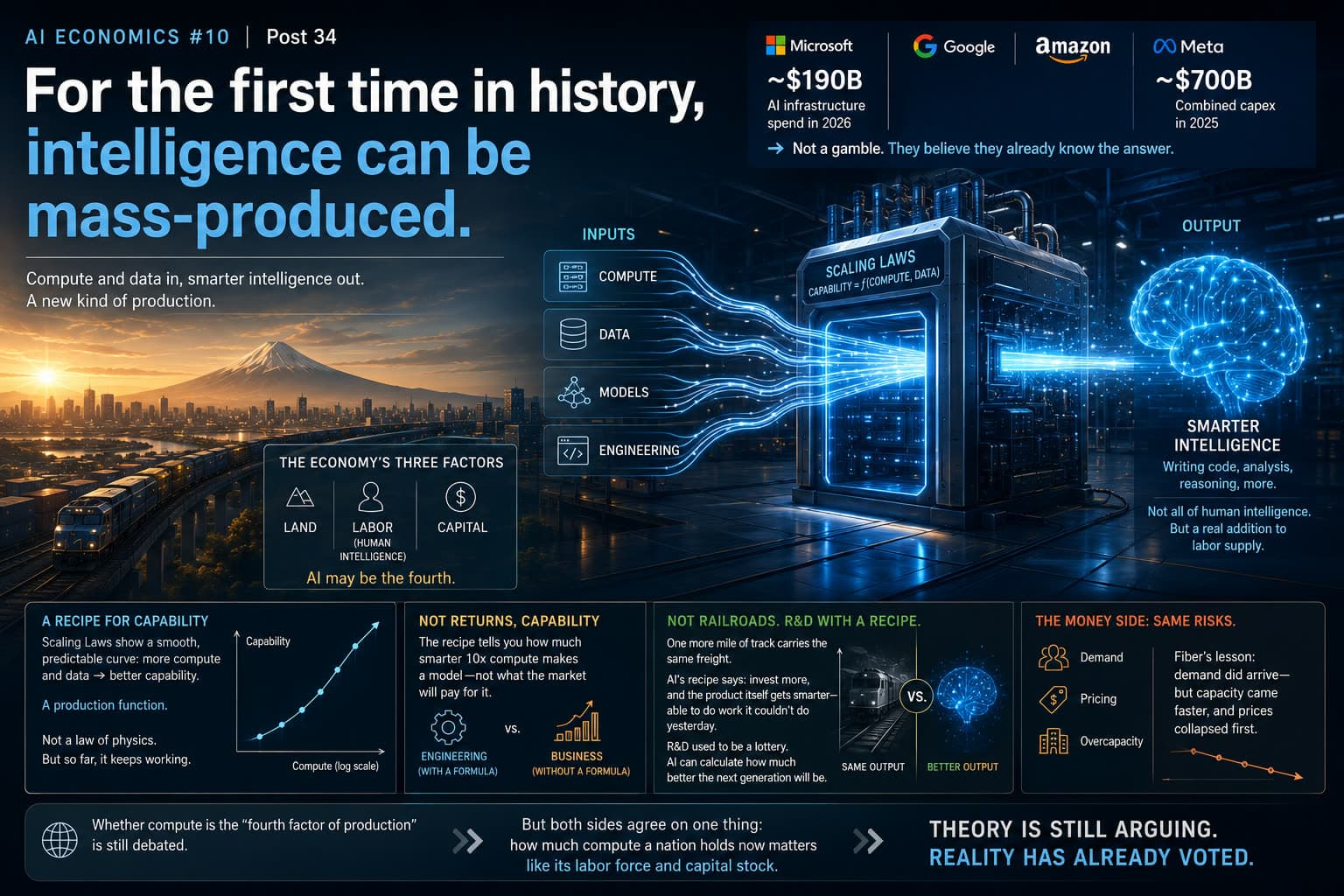
For the first time in history, intelligence can be mass-produced.
The Scale of the Bet
Microsoft plans to spend ~$190B on AI infrastructure in 2026 — enough to buy Disney outright. Together, Microsoft, Google, Amazon, and Meta will spend nearly $700B in capex this year, close to Japan's entire national budget.
Many call this a gamble. It isn't. A gamble implies unknown odds — these companies believe they already know the answer.
Intelligence as a Factor of Production
Economics reduces production to three factors: land, labor, capital. Labor is special because behind it sits human intelligence — judgment, reasoning, creativity. Machines could replace muscle (that was the Industrial Revolution), but intelligence could only come from people. How much "smart" a society had depended on population and education. You couldn't rush it.
AI changes that. Feed in compute and data; out comes a model that writes code, runs analysis, does real cognitive work. Not all of human intelligence — intuition, taste, true originality are nowhere close. But the standardized, well-defined slice of knowledge work can now be mass-produced. That's a real addition to labor supply.
The Recipe for Intelligence
Here's the stranger part: making intelligence comes with a recipe.
Scaling Laws: capability improves along a smooth, predictable curve as compute and data grow. In economic terms, a production function. That's almost unheard of — open ten restaurants, and nobody can promise the tenth performs like the first. Not a law of physics, but so far it keeps working.
One crucial distinction: the recipe predicts capability, not returns. It tells you how much smarter 10x compute makes a model — not what the market will pay for that intelligence. The first is engineering, with a formula. The second is business, without one.
What Makes AI Different From Railroads
"Didn't railroads and fiber companies also know their input-output math — and still go bust?" Yes. But the difference is the output. One more mile of track carries the same freight. AI's recipe says: invest more, and the product itself gets smarter. That's not manufacturing; it's R&D with predictable output. R&D used to be a lottery — nine in ten drugs fail. AI is the first industry that can calculate in advance how much better its next generation will be.
On the money side, though, AI inherits every risk fiber had. Fiber's lesson: demand did arrive — but capacity arrived faster, and prices collapsed first.
Compute as National Resource
Whether compute becomes the "fourth factor of production" is still debated. But both sides agree on one thing: how much compute a nation holds now matters the way its labor force and capital stock do. Theory is still arguing. Reality has already voted.
The One-Sentence Takeaway
The one-sentence takeaway: compute deserves to be taken seriously not because it's expensive, but because of the unprecedented thing behind it — for the first time, humanity holds the production recipe for intelligence, at least its standardizable part. Inputs are measurable, capability is calculable. Intelligence has gone from a gift to a production capacity.
Takeaways
AI is the first industry that can calculate in advance how much better its next generation will be.
Theory is still arguing. Reality has already voted.
For the first time, humanity holds the production recipe for intelligence, at least its standardizable part.
Was this useful?