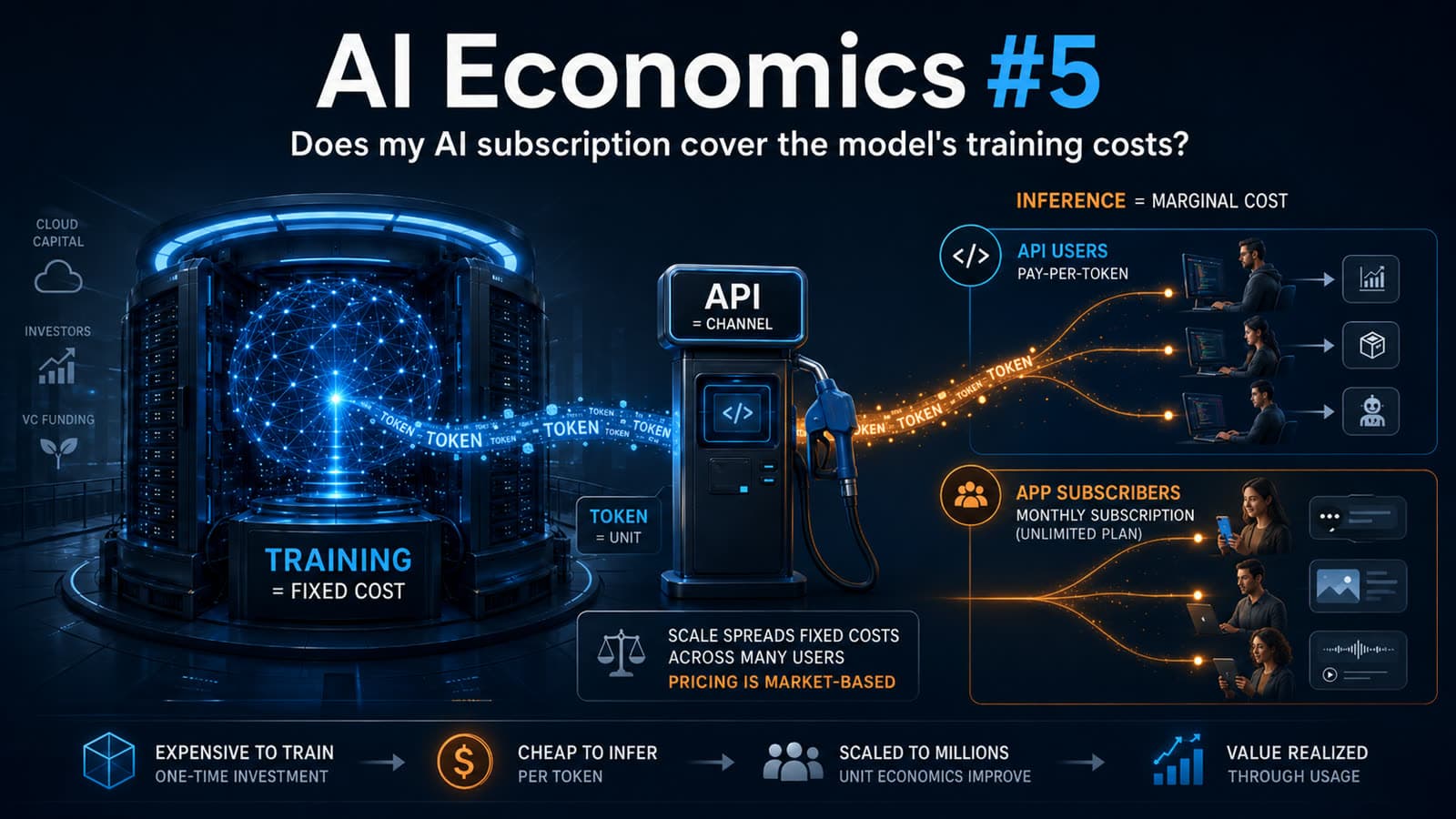
"Does my AI subscription cover the model's training costs?"
A friend asked me this recently. It sounds simple, but it pulls on the core thread of AI economics: how costs arise, how bills form, and what tokens actually do.
The short answer: not in the pricing, but yes in the logic.
How AI Pricing Actually Works
AI companies don't price subscriptions as "inference cost + amortized training cost." Prices are set by what users are willing to pay and by market competition — especially competitors' pricing, the most direct anchor. It's market pricing, not cost-plus.
But every dollar spent on training must eventually be covered by revenue. Training costs are typically capitalized or booked as R&D, and recouped through gross margin — revenue minus the marginal costs of inference (compute, electricity). So consumers do bear training costs, indirectly. It just never shows up as a line item.
Fixed vs. Marginal Costs
The key structural difference: - Inference is a marginal cost: more users, more usage, more spend. - Training is a fixed cost: train once, everyone shares it.
The bigger the user base, the thinner the training cost per user. That's why AI companies fight so hard for scale — scale itself dilutes fixed costs.
Today's reality: many companies' revenue still doesn't cover training plus inference. The gap is filled by VC money and Big Tech capital — in a sense, today's users are running AI at subsidized prices.
APIs, Tokens, and How Bills Form
So how is the bill calculated? Two words: API and tokens. Not the same thing, and one doesn't contain the other: - API is the channel — how developers access the model via code. - Token is the unit — the smallest chunk of text a model processes, roughly a word or part of one. It measures usage.
My favorite analogy: a gas station. The API is the pump; the token is the liter. Fuel flows through the pump, priced per liter. Nobody asks whether the pump and the liter are the same thing.
Two Customer Types
This maps to two customer types: - Developers use the API and pay per token — like pay-as-you-go data. Input and output are priced separately (output costs more: generating text takes more compute than reading it). - Consumers use the app and pay a subscription — like an unlimited plan. Light users effectively subsidize heavy users.
And note: subscribers still burn tokens with every chat. The only difference is the bill — API users pay per token; subscribers pay monthly, with tokens hidden inside the fee.
Three Layers of AI Economics
Pulling it together: 1. Cost structure = fixed training cost + marginal inference cost 2. Pricing follows the channel: API access is metered per token; the app is a flat monthly subscription. 3. Tokens are just the measuring stick — what's really being priced is compute.
Understand these three layers, and you understand the economics behind your AI bill.
But the bill is only half the story. When tokens cross borders, another set of rules kicks in — regulation. Next post: "In AI trade, what exactly is being controlled?"
Takeaways
So consumers do bear training costs, indirectly. It just never shows up as a line item.
That's why AI companies fight so hard for scale — scale itself dilutes fixed costs.
Subscribers still burn tokens with every chat. The only difference is the bill — API users pay per token; subscribers pay monthly, with tokens hidden inside the fee.
Was this useful?