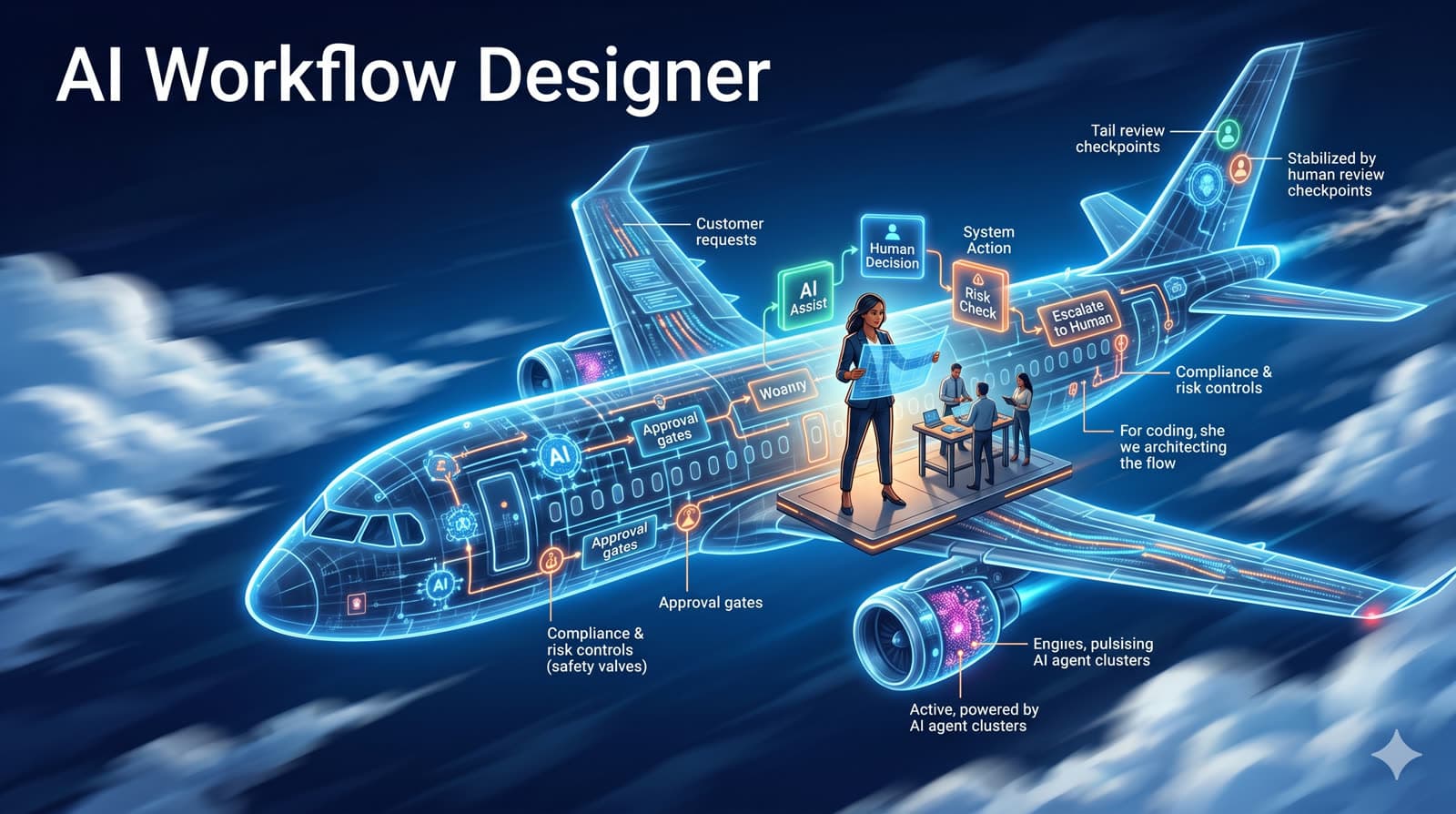
AI Workflow Designer
One role at a time. Understand what it is, who it fits, and how to enter.
The Wrong First Question
When companies start AI transformation, the first question is often: Can we add an Agent to this process? But the more important question is: Should this workflow be redesigned first?
"Do not automate chaos" is not new. Companies learned this from ERP, RPA, and digital transformation. But AI makes the problem harder. An AI Agent does not only follow rules. It can understand context, generate content, make recommendations, and trigger next steps. Workflow design is no longer just about automation. It is about reallocating tasks, decisions, permissions, responsibilities, and human oversight. This is where the AI Workflow Designer comes in.
Defining the Role
In one sentence: An AI Workflow Designer redesigns business workflows by deciding where AI should intervene, where humans must decide, and how people, systems, and AI should work together in a trackable and governable way.
This is not yet a mature standalone job. It is an emerging set of responsibilities evolving from AI product managers, business analysts, process managers, operations leaders, and consultants. For example, in a customer complaint process, AI can classify complaints, extract key information, match historical cases, and draft replies. But refunds, legal risks, compensation, or escalations must still involve humans. The system also needs to record AI suggestions, human edits, and final outcomes. So this role is not designing a tool. It is designing a new human-AI collaboration mechanism.
Who Has a Starting Point
People from process management, operations, product, business analysis, consulting, customer operations, sales operations, or supply chain operations may have a strong starting point. HRBPs may also enter this direction, but their edge is not process design itself. It is understanding how AI changes roles, capability models, and organizational collaboration.
The Real Question to Ask
In the AI era, the key question is not: Should we use an Agent? It is: Which tasks should AI handle, which decisions must stay human, and which responsibilities must never be blurred by the system?
The real challenge is not making old workflows AI-enabled. It is redesigning how humans, AI, and systems work together.
Takeaways
Workflow design is no longer just about automation. It is about reallocating tasks, decisions, permissions, responsibilities, and human oversight.
So this role is not designing a tool. It is designing a new human-AI collaboration mechanism.
The real challenge is not making old workflows AI-enabled. It is redesigning how humans, AI, and systems work together.
Was this useful?