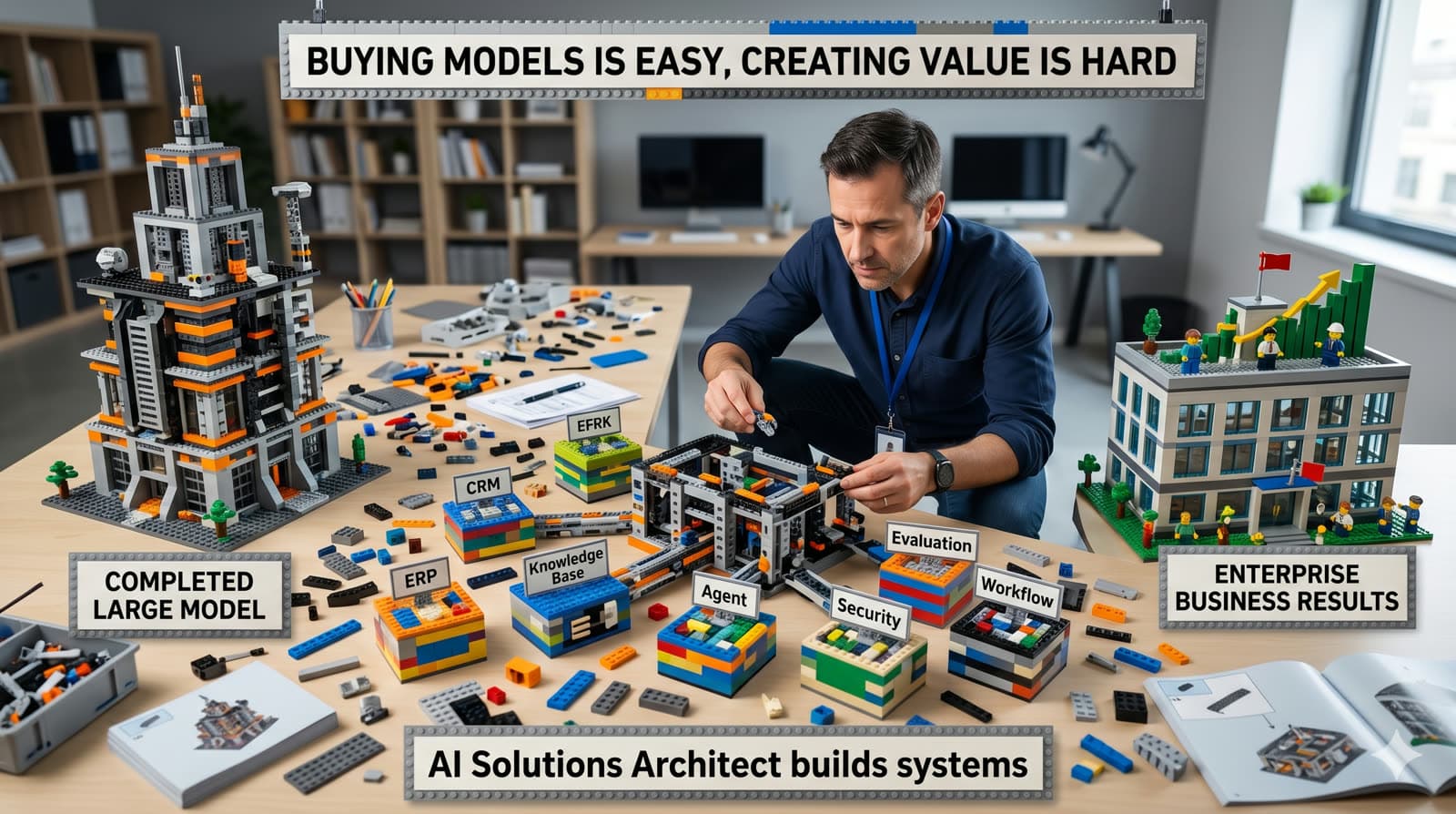
AI Solutions Architect
Each episode breaks down one emerging AI-era role. Understand what it is, who it’s for, and how to break into it.
Why More Architects Are Needed
As AI gets stronger, why do companies need more architects, not fewer? Because using AI models is becoming incredibly easy. The real challenge is no longer having AI — it's embedding AI into business systems. And system integration is one of the hardest capabilities to scale.
Over the past two years, foundation models have advanced rapidly. Connecting to GPT, Claude, or Gemini now takes minutes. Yet many companies have discovered that buying AI is easy; creating business value is not.
The Real Challenge: Integration
Imagine a bank launching an AI-powered customer service platform. The challenge isn't the model itself. It's deciding what data AI can access, integrating with CRM systems, managing compliance and audit requirements, controlling inference costs, handling AI mistakes, and ensuring the system can evolve without constant rework. That's where an AI Solutions Architect comes in.
What the Role Involves
In one sentence: They turn AI capabilities into business productivity. Typical responsibilities include: - Designing end-to-end AI system architectures - Orchestrating data flows, workflows, and AI agents - Selecting models, tools, and technology stacks - Leading PoCs and implementation roadmaps - Establishing AI governance, risk, and compliance frameworks - Measuring business impact and ROI
In practice, the role usually exists in two forms: - Enterprise-side (in-house): Builds and operates AI systems while being accountable for business outcomes. - Vendor-side (cloud providers and technology firms): Helps customers design solutions, validate value, and drive adoption—such as Solutions Architects at AWS, Azure, or Google Cloud. If an AI Engineer asks, "How do we build this component?" An AI Solutions Architect asks, "How do all components work together to achieve a business goal?"
Who Can Transition Into This Role
*Who can transition into this role? * Cloud Architects, Solutions Consultants, Technical Pre-Sales professionals, Tech Leads, and Digital Transformation Leaders. - Pre-sales and consulting backgrounds often fit the vendor-side path. - Architecture, engineering leadership, and transformation experience often fit the enterprise path. Key skills to develop include: LLM fundamentals, RAG and Agent architectures, AI evaluation (Evals), LLMOps, and AI governance.
The Scarce Capability Going Forward
As AI models become increasingly commoditized, competitive advantage shifts elsewhere. The scarce capability is no longer owning AI—it's knowing how to embed AI into organizations, processes, and business operations. And that is exactly why AI Solutions Architects are becoming more valuable.
Takeaways
Yet many companies have discovered that buying AI is easy; creating business value is not.
If an AI Engineer asks, "How do we build this component?" An AI Solutions Architect asks, "How do all components work together to achieve a business goal?"
The scarce capability is no longer owning AI—it's knowing how to embed AI into organizations, processes, and business operations.
Was this useful?