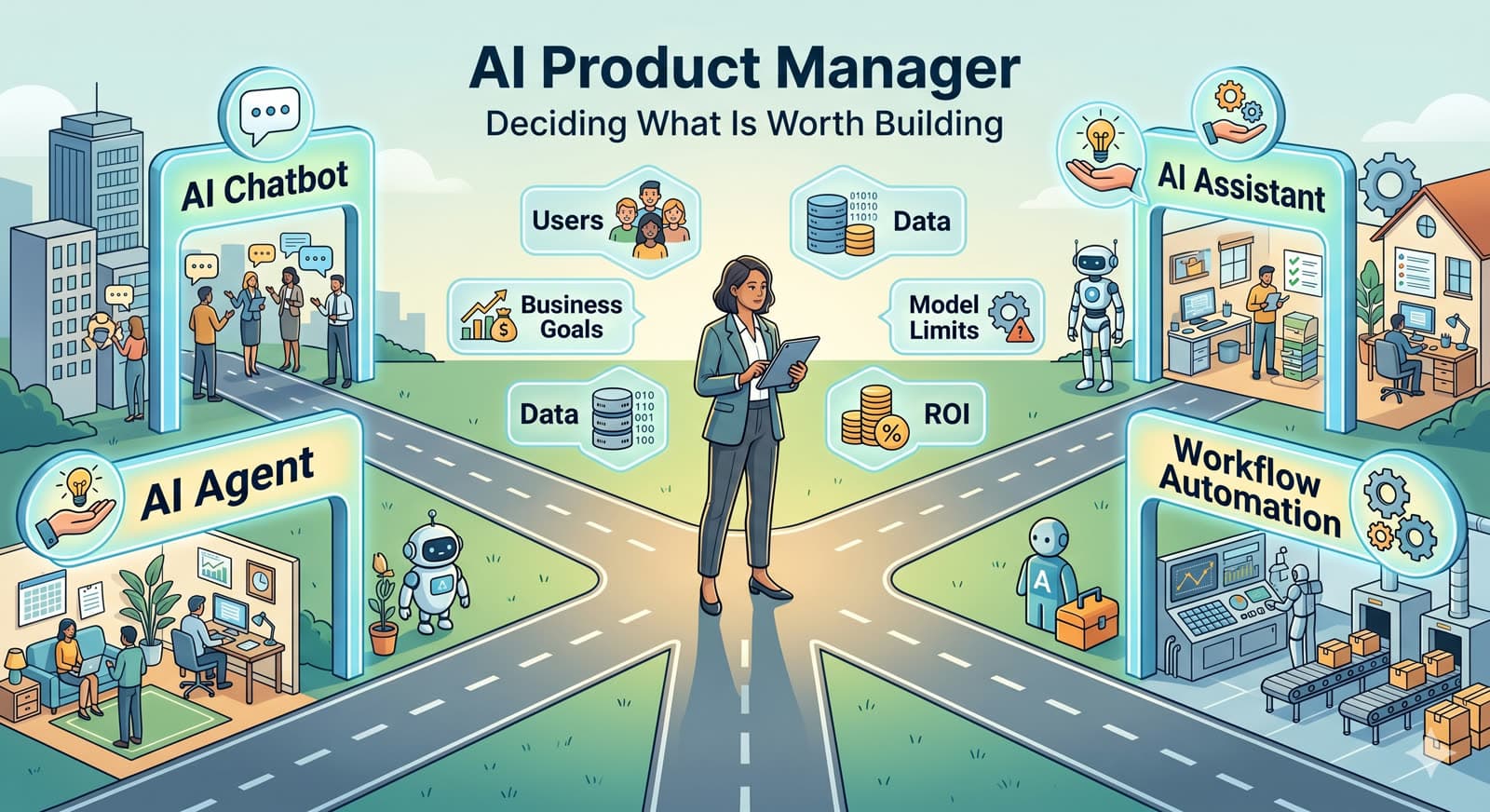
AI Product Manager
Each episode breaks down one emerging AI-era role. Understand what it is, who it’s for, and how to break into it.
AI Product Manager: As AI Gets Smarter, Will Product Managers Become More Important or Obsolete?
The Core Misconception About PMs
Over the past year, I've heard the same question again and again: "If AI can already write PRDs, do companies still need Product Managers?" The question is based on a common misconception. Many people think Product Managers are responsible for writing requirements documents. In reality, that's only a small part of the job. A simpler way to think about it: If AI Engineers build capabilities and FDEs help deploy them, AI Product Managers decide what is worth building in the first place.
Deciding What Should Be Built
Imagine an e-commerce company looking to improve customer service with AI. Should it build an AI chatbot? A customer support assistant? A sales agent? Or an automated workflow? The technology team may be able to build all of them. But resources are always limited. The real challenge isn't whether something can be built. It's deciding what should be built first. That's where AI Product Managers create value. They combine user needs, business goals, and technical realities to determine which problems are worth solving.
How AI PMs Differ From Traditional PMs
*What makes AI Product Managers different from traditional Product Managers? *
They don't just need to understand users. They also need to understand AI. Traditional software is largely deterministic. You click a button and expect a predictable outcome. AI products are different. The same prompt may generate different answers. Models can hallucinate, make mistakes, or behave unexpectedly in edge cases. As a result, AI Product Managers must constantly think about questions such as: - Where are the limits of the model? - Which decisions should be handled by AI? - Which decisions still require human oversight? - And what happens when the AI gets it wrong? These are becoming essential product decisions in the AI era.
Skills Companies Are Paying For
- So what skills are companies actually paying for? *
- First, the ability to identify high-value problems. As AI technology becomes more accessible, finding the right problem to solve becomes increasingly valuable.
- Second, systems thinking. AI products are rarely just features. They involve models, data, workflows, and human collaboration working together as a system.
- Third, judgment. AI can generate hundreds of ideas. But deciding which ideas are feasible, worth investing in, and capable of creating business value still requires human judgment.
Making Decisions Under Uncertainty
*What's the real barrier to entry? * It's not writing PRDs. It's making decisions under uncertainty. Technology changes. User needs evolve. Markets shift. Every day, AI Product Managers are asking the same question: "Given what we know today, what is the most valuable thing to build next?"
Who Transitions Most Successfully
*Who transitions into this role most successfully? * Traditional Product Managers often have the most direct path because they already understand users and business priorities. Consultants, business analysts, and founders also have strong foundations due to their experience solving complex problems. Engineers often have an advantage in understanding model capabilities and technical constraints, but may need to strengthen their user perspective and prioritization skills.
The Truly Scarce Skill
In the past, the most valuable people defined features. In the future, the most valuable people may be those who define the right problems. Because as AI becomes better at generating answers, the truly scarce skill will be knowing which questions are worth asking. And that's exactly where AI Product Managers thrive.
Takeaways
The real challenge isn't whether something can be built. It's deciding what should be built first.
Because as AI becomes better at generating answers, the truly scarce skill will be knowing which questions are worth asking.
Was this useful?