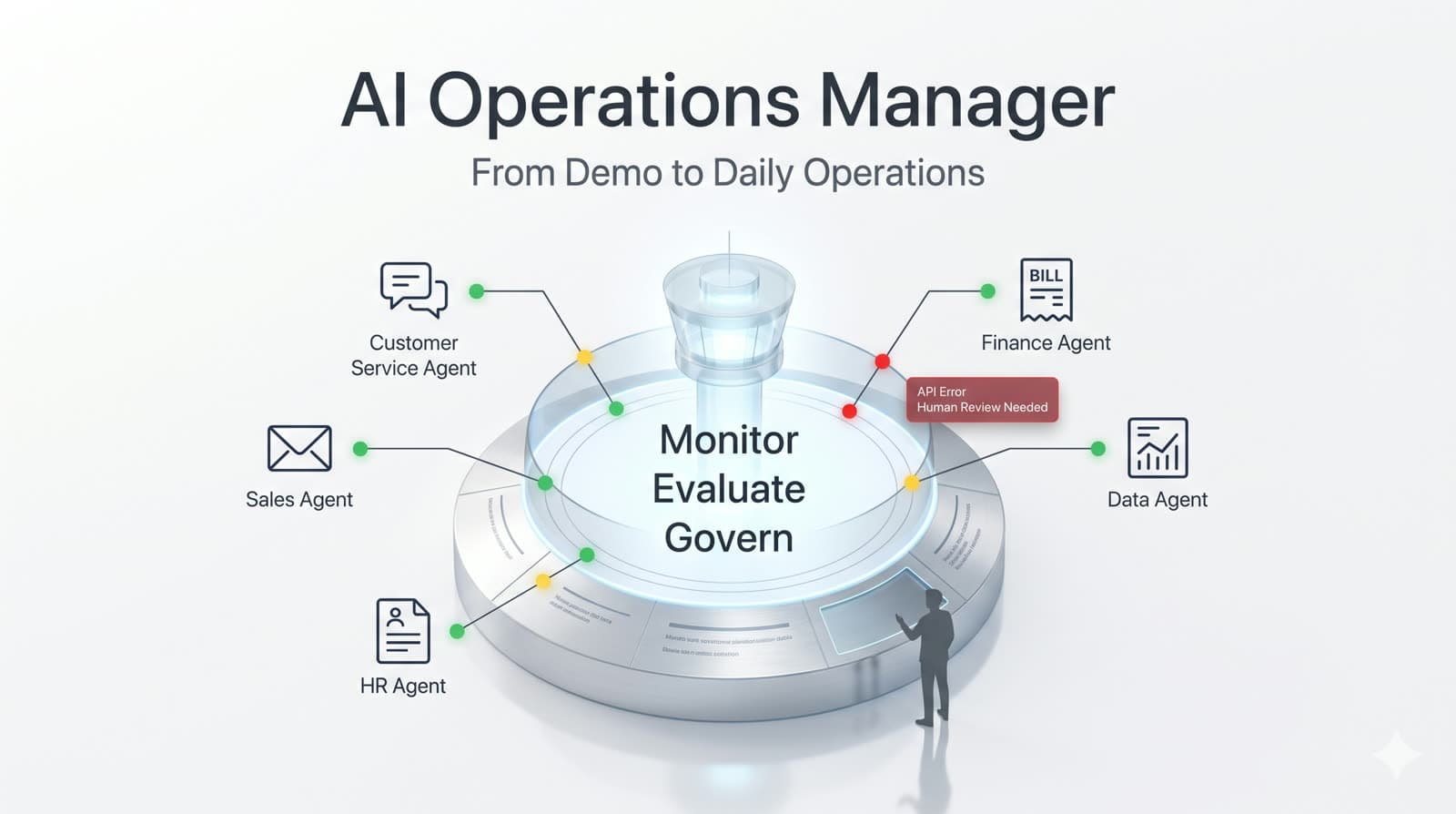
AI Operations Manager.
Each post breaks down one emerging AI role: what it is, who it suits, and how to move into it.
When companies move AI agents from demos into real workflows, who makes sure they keep running safely and effectively?
From Demo to Daily Operations
Getting an agent to work once does not mean it creates value. It may call the wrong knowledge base, produce weaker answers, burn tokens, break when an API changes, or keep acting when a human should step in. Unlike traditional automation, agents generate judgments and actions based on context.
That is why companies need more than agent builders. They need someone to manage performance, cost, risk, and accountability in daily operations. This is the AI Operations Manager: the person who turns AI agents from one-off deployments into monitored, measurable, and governable operational capabilities.
Where This Role Comes From
This role is not created from nowhere. It does not replace MLOps, LLMOps, Technical Program Managers, or platform product managers. It is a set of responsibilities emerging as AI agents enter real business environments.
MLOps focuses on model deployment and lifecycle management. LLMOps extends this to large language model applications: prompts, tool calls, evaluation, cost, latency, and safety. AI Operations Manager sits closer to the business front line: not only asking whether the system runs, but whether AI completes real tasks and creates measurable outcomes.
Can existing TPMs, platform PMs, or IT operations leaders take this on? Yes. Many already do. But as agents move from pilots into more workflows, the work starts to need a clearer owner across technology, product, operations, and compliance.
The Real Difference From Traditional Operations
The real difference from traditional operations is not "people vs digital workers." Traditional operations managers already manage systems and automation. The difference is that AI agents introduce uncertainty and semi-autonomous decisions. The question shifts from "Was the process followed?" to "Was the AI judgment reliable, was the boundary clear, and was the risk controlled?"
Agents are not legal employees. When something goes wrong, responsibility goes back to system design, permissions, approvals, human oversight, and governance.
Who Is Best Positioned
People from MLOps, LLMOps, AI product operations, platform operations, TPM, platform product, and IT operations have the closest starting point. Business operations professionals can also move in this direction, but the learning curve is real.
A Real Capability Gap
AI Operations Manager may not become a large-scale hiring title immediately. But it points to a real capability gap: as AI moves from demo to daily operations, someone must own its stability, impact, cost, and risk.
Takeaways
Unlike traditional automation, agents generate judgments and actions based on context.
The question shifts from "Was the process followed?" to "Was the AI judgment reliable, was the boundary clear, and was the risk controlled?"
As AI moves from demo to daily operations, someone must own its stability, impact, cost, and risk.
Was this useful?