AI Agent Builder
One role at a time: what it does, who it fits, and how to enter.
When companies start having "digital employees," who designs how they work?
Software Becomes the Worker
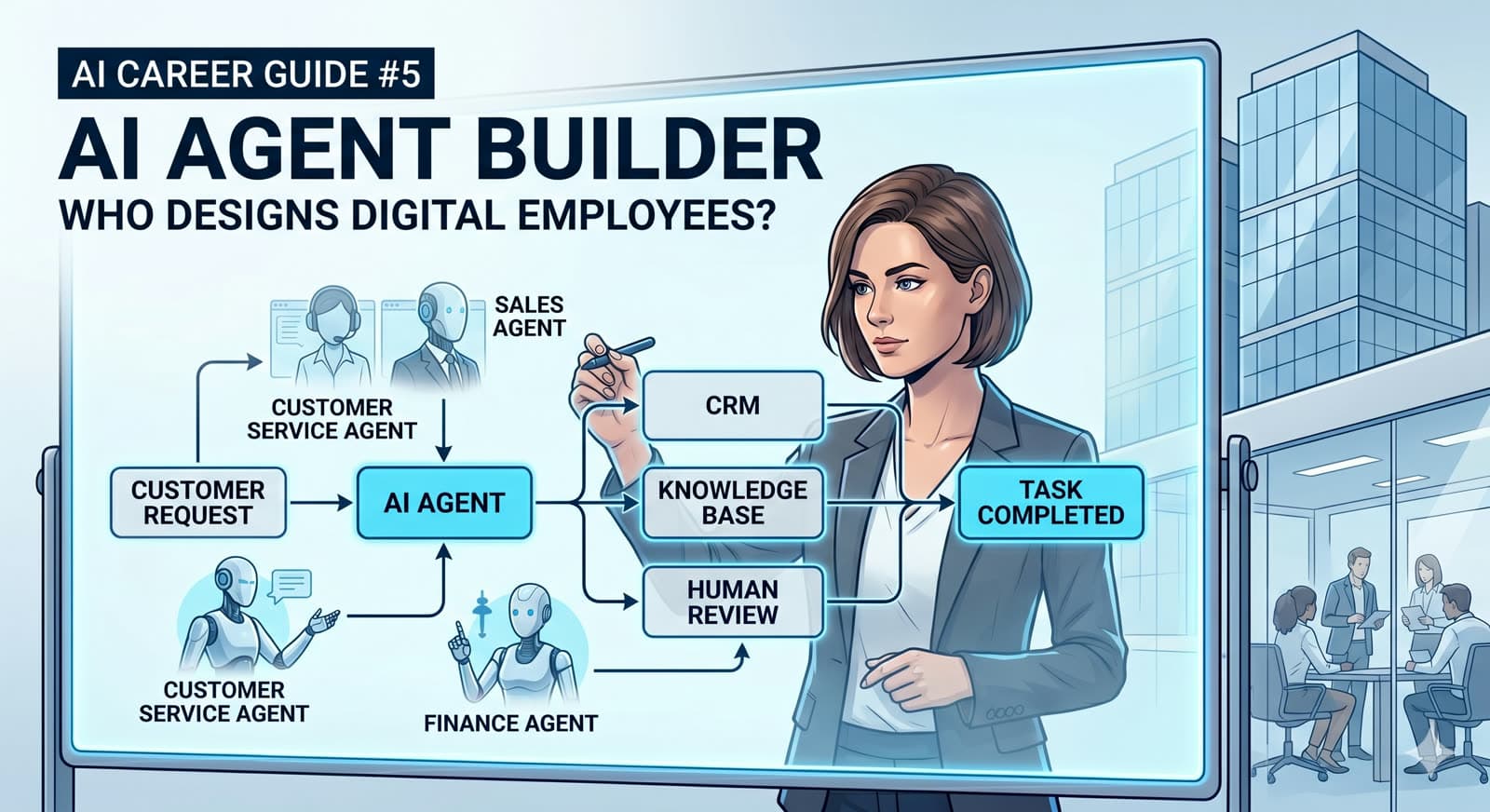
In the past, software was a tool used by people. Now, software is beginning to take on work directly: customer service agents answer questions, sales agents identify leads, HR agents screen resumes, procurement agents compare quotes, and finance agents organize reimbursements.
These agents are no longer just chatbots. They have goals, permissions, knowledge bases, and the ability to call different systems to complete tasks.
That is why a new role is emerging: AI Agent Builder.
What the Role Actually Is
In one sentence: An AI Agent Builder designs, configures, deploys, and continuously improves digital employees.
Many people think this role is about "writing prompts." But whether an agent works well depends on a broader mechanism: What task should it complete? What data can it access? When should it call tools? When must it escalate to a human? How do we measure quality and improve errors?
So what an Agent Builder really designs is not a prompt, but a mechanism for how AI gets work done.
Two Pathways Into the Role
There are two common pathways.
The first is the low-code/platform-based path. Builders use tools such as Coze, Dify, Botpress, Voiceflow, n8n, or Zapier to quickly build and test agent scenarios. This path emphasizes business understanding, process design, and scenario implementation. It suits product managers, operations leads, HRBPs, process consultants, and digital transformation professionals.
The second is the engineering-oriented path. Builders use frameworks such as LangGraph, CrewAI, or AutoGen to build more complex, stable, and scalable agent systems. This path requires stronger programming, system design, and engineering capabilities. It suits AI engineers, tech leads, software architects, and system integration engineers.
So the key question is not whether business or technology matters more. The real question is: Can this agent complete a real task in a stable, controllable, and measurable way?
How This Role Differs
This also explains how Agent Builder differs from AI Engineer and AI Solutions Architect. AI Engineers usually start from technical implementation. AI Solutions Architects focus on the overall AI system architecture. Agent Builders focus on the task design and execution quality of specific agents.
The Emerging Scarce Capability
In the AI era, company growth may not always start with hiring more people. It may start with deploying more agents.
As organizations manage both human employees and digital employees, a new scarce capability will emerge: turning real business workflows into agent-based work systems that can be executed, evaluated, and continuously improved.
That is the value of the AI Agent Builder.
Takeaways
So what an Agent Builder really designs is not a prompt, but a mechanism for how AI gets work done.
In the AI era, company growth may not always start with hiring more people. It may start with deploying more agents.
As organizations manage both human employees and digital employees, a new scarce capability will emerge: turning real business workflows into agent-based work systems that can be executed, evaluated, and continuously improved.
Was this useful?